Time is saved by automation. Digital agility changes a company’s growth, adaptation, and way of thinking. Claris FileMaker has long been known as a rapid app-builder — but its real, under-celebrated strength is enabling digital agility: the ability for organizations to iterate quickly, respond to changing workflows, and convert frontline ideas into production-ready systems with minimal friction. This post explains what that means, why it matters, and how FileMaker delivers it in ways that go far beyond simple automation.
What is “digital agility” — and why it’s more important than automation alone
Automation focuses on repeating tasks faster or cheaper. Digital agility is a broader capability: it’s the speed and ease with which an organization can redesign processes, test new workflows, and deploy changes that create new value. Agile teams are not just automating what exists — they’re reframing problems, experimenting, and evolving systems as business needs change. That mindset reduces technical debt and keeps companies competitive as markets shift.
How FileMaker enables true digital agility
1. Rapid prototyping and iterative development (low-code + visual tools)
FileMaker’s drag-and-drop layout design and script-builder let teams build clickable prototypes and real apps in hours or days rather than weeks or months. That short feedback loop—prototype → test with users → iterate—makes it practical for non-technical stakeholders to shape solutions directly, which is the heart of being agile. Rapid iteration reduces risk and shortens the time between insight and impact.
2. Built-in extensibility and modern integrations
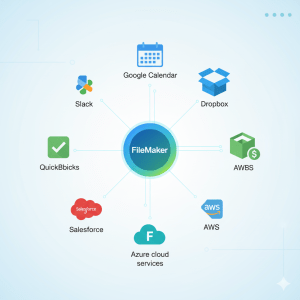
Modern business apps must play nicely with other systems. FileMaker’s improved API, JSON handling, and connectors (including Claris Connect/Studio relationships) make it straightforward to integrate CRMs, ERPs, document stores, and web services. Instead of rebuilding processes around rigid, off-the-shelf software, teams can stitch together best-of-breed tools and adapt as needs evolve. This reduces vendor lock-in and lets organizations evolve their stack incrementally.
3. New AI and productivity features that change what you can build
The 2025 FileMaker release added explicit AI script steps (for example, Generate Response from Model) and utility functions like GetTextFromPDF(), which mean capabilities that once required separate services or plugins can now be embedded natively. That makes it faster to prototype smart features—automated summaries, document extraction, or conversational helpers—while keeping control of data and logic inside your app. These platform-level features accelerate experiments and let teams move from idea to production with less overhead.
4. Cross-platform delivery and user adoption
FileMaker apps run on desktop, iOS, and the web (via Claris Studio), so prototypes become useful tools across the company without a separate mobile project. That easy reach increases adoption and shortens validation cycles: you can release a change to users, watch behavior, and refine quickly. High adoption is what turns incremental automation into organizational change.
5. Cost-effective and maintainable vs. monolithic ERPs
Large ERPs often require long procurement cycles and expensive customization. FileMaker lets small and mid-sized teams build tailored solutions at a fraction of the time and cost, with easier maintenance. That cost advantage lets organizations keep experimenting (and improving) without fearing sunk costs—an important enabler of agility.
Real-world ways digital agility looks in FileMaker projects
- Process reinvention: A customer service team prototypes a case-tracking workflow in days, tests it for two weeks, and folds improvements into production—no long development cycle.
- Smart document handling: With
GetTextFromPDF()an office moves from manual data entry to automatic extraction and verification, freeing staff to handle exceptions and strategy. - Embedded AI helpers: Sales teams get auto-generated meeting notes and next-step suggestions via the new AI script step, improving responsiveness without extra headcount.
How to move from automation projects to true digital agility (practical roadmap)
- Start with outcome-focused prototypes. Build a minimal app that solves a single pain point; test in production with a small user group. (FileMaker is ideal for this.)
- Instrument and measure. Add simple logging: time-to-complete, error counts, user satisfaction. Use that feedback to iterate.
- Treat integrations as first-class features. Plan APIs early so your prototype can become a composable part of your stack.
- Use built-in capabilities first. Try native features (PDF text extraction, AI script steps) before adding third-party complexity. This keeps ownership and speeds up iteration.
- Govern but don’t gatekeep. Provide guardrails (security, backups, testing checklist) so many teams can safely experiment without central IT becoming a bottleneck.
Risks and mitigations
- Risk: Over-customization -> fragmented apps.
Mitigation: Use modular design and central data models where possible (shared APIs/standards). - Risk: Rushed deployments causing bugs.
Mitigation: Keep short, repeatable test cycles and a rollback plan. - Risk: Misplaced AI trust.
Mitigation: Always include human review for sensitive outputs; use AI as augmentation, not autopilot.
Conclusion — why this matters for business leaders
Automation reduces cost; digital agility creates new value. Claris FileMaker’s low-code speed, native AI hooks, stronger API/JSON support, and cross-platform reach combine into a practical platform for experimentation and continuous improvement. Organizations that treat FileMaker as a strategic tool for rapid learning—not just a task-automation engine—will move faster, adapt sooner, and capture opportunities that rigid systems miss.