People frequently envision developers as being exact, rational, and code-focused. However, proficient FileMaker developers are required to be both creative designers and meticulous systems thinkers. FileMaker developers combine creativity and logic to create business apps that people want to use in the low-code world, where usability and speed are just as important as accuracy.
Below we unpack how that balance works in practice, what’s changed with FileMaker’s 2025 release and the broader Claris ecosystem, and concrete steps developers can take to level up their craft.
1. Why FileMaker development demands both halves of the brain
FileMaker sits between rapid application development and full-stack engineering. A successful FileMaker solution must do three things at once: map messy real-world processes into structured data, provide an intuitive interface so non-technical staff adopt it, and integrate reliably with the rest of the IT ecosystem.
That means FileMaker developers must:
- Understand people (how users think, what they need, what trips them up).
- Design workflows that are obvious and efficient.
- Engineer data relationships and scripts that scale and stay maintainable.
This duality (creative UX + logical architecture) is what turns “a working database” into “a tool that transforms work.” Claris has emphasized this human-centered approach in developer resources and community guidance, urging developers to pair UX best practices with robust logic.
2. What changed in 2025 — and why it makes the creative/logical balance even more important
Claris released a major 2025 update to FileMaker that places AI, integrations, and cloud capabilities front and center. New AI features and deeper platform integration mean developers are expected to design not only screens and scripts, but also intelligent workflows that enhance decisions and automate complex tasks. FileMaker’s 2025 release (announced July 8, 2025) and the Claris Engage 2025 conversations confirmed AI as a core enabler for everyday apps.
Practical impact:
- Developers can now embed AI-assisted functionality (summaries, suggestions, classification) directly into apps, which raises UX expectations — interfaces must surface AI results clearly and responsibly.
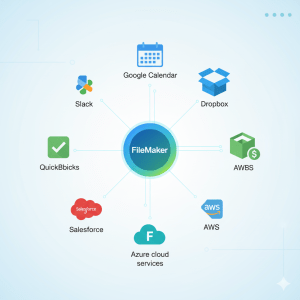
- The broader Claris ecosystem (Claris Connect, Claris Studio, Claris Cloud) makes apps part of larger automated workflows — developers must design data flows and error handling across systems.
In short: more power → more responsibility. Creativity must now include ethical and explainable presentation of automated results; logic must encompass integrations and AI governance.
3. The developer skillset: what “balancing creativity and logic” actually looks like
Here are the practical skills and habits that separate great FileMaker developers from merely competent ones.
Design & UX sensibility
- Layout hierarchy, visual affordances, and microcopy that reduce cognitive load.
- Design patterns optimized for real users (portals, conditional formatting, progressive disclosure).
- Usability testing or rapid user feedback loops.
Data modeling & architecture
- Sound entity-relationship design and indexing strategy to keep performance healthy as data grows.
- Naming conventions and modular scripts for maintainability.
- Server vs client responsibilities (what to run server-side for scalability).
Integration & automation
- REST/JSON workflows, authenticated API calls, and Claris Connect automation patterns.
- Idempotent operations and robust error handling for multi-system flows. (Claris)
AI literacy
- Knowing what tasks to delegate to AI (classification, summarization, suggestions) and how to present outputs safely and transparently.
- Validation checks around AI outputs—never treat an LLM reply as definitive without guardrails.
Soft skills
- Interviewing stakeholders to turn domain knowledge into concrete app requirements.
- Mentoring “citizen developers” and documenting reusable components (templates, starter libraries).
4. UX & performance: design isn’t just pretty — it’s measurable
Design choices affect adoption, error rates, training time, and ultimately ROI. That’s why FileMaker devs track UX outcomes:
- Reduced task completion times after a redesign
- Decrease in manual errors after automation
- Increase in daily active users of an internal tool
Performance is equally important: a beautiful layout that queries dozens of unstated related records will slow to a crawl. Developers must balance the visual richness of a layout with the efficiency of relationships, indexing, and server scripting. Community guidance and design tutorials for FileMaker emphasize this pragmatic approach.
5. Real examples: creativity + logic in action
Example A — Sales Operations App
- Creative: Dashboard with quick filters, color-coded priority flags, and one-click task creation.
- Logical: Proper indexing of contact/activity tables, server script that batches large imports, API sync to CRM with retry logic.
Example B — Field Service App with AI
- Creative: Natural language notes entry and auto-summaries for managers.
- Logical: Local validation of critical fields, AI inference routed to a review step before being committed to records, audit trail for AI outputs.
Both examples show the need to design experiences that feel effortless while safeguarding data integrity and process correctness.
6. Practical checklist: a FileMaker developer’s pre-launch QA
Before you ship, run through this checklist:
- User walkthroughs — 3 non-technical users perform core flows.
- Performance smoke test — populate with representative data and measure key screens.
- Integration resilience — test API failures and network timeouts.
- AI governance — add human review steps where decisions matter.
- Accessibility — labels, tab order, contrast checks.
- Documentation — workflow diagrams + script index for future maintainers.
This checklist helps preserve the creative UX you designed while ensuring the underlying logic holds up.
7. How teams should empower FileMaker developers
To maximize impact, organizations should:
- Give developers direct access to stakeholders so they can learn domain context.
- Invest in UX training and time for design exploration (not just quick fixes).
- Support continuous learning (Claris Engage, community sessions, and design resources).
- Define governance for citizen development so speed doesn’t compromise security and maintainability.
8. The future: where the balance goes next
As FileMaker’s built-in AI and cross-platform tools mature, developers will increasingly act as orchestrators of intelligent workflows — designing humane interfaces while wiring together services, AI, and cloud infrastructure. The best developers will be those who treat creativity and logic as complementary design constraints: one that delights users, the other that sustains the business.
Conclusion
Being a top FileMaker developer in 2025 isn’t about choosing sides — it’s about merging them. Creativity gets users to adopt your app. Logic keeps it reliable, fast, and secure. In today’s low-code landscape — supercharged with AI and integrated ecosystems — developers who master both will build solutions that last.