The Claris Platform SDK (and the broader Claris Platform evolution) is transforming FileMaker development from a single-tool, desktop-centered workflow into a hybrid, extensible, cloud-aware developer experience. It brings deeper integration points (web and API-first patterns), closer ties to Claris Studio and Claris Connect, stronger support for JavaScript and modern tooling, and new opportunities to embed AI and web experiences into FileMaker solutions. For FileMaker developers this means more powerful integration options, a larger surface for building custom extensions and web experiences, and a clear need to broaden technical skills (APIs, JavaScript, cloud architecture, and AI-aware design).
1) What changed — a short primer
Over the past couple of years Claris has repositioned FileMaker as part of a unified Claris Platform that includes FileMaker (Claris Pro/Server/Cloud), Claris Connect (integration/automation), and Claris Studio (web-first views and experiences). The Platform SDK is the engineering bridge: it exposes stable extension points and APIs so developers can create richer integrations, web components, custom runtimes, and automation—while keeping FileMaker’s core low-code strengths. This shift is part of the 2024–2025 releases that emphasize cloud, integration, and AI capabilities.
2) Why this matters to FileMaker developers
a) Move from monolithic apps → modular, web-friendly apps
FileMaker solutions can now more easily be integrated with external services and surfaced in Claris Studio views. This implies that developers will now consider APIs, micro-frontends, and embedded web components instead of just layouts and scripts. This creates opportunities for external stakeholder dashboards, public-facing portals, and hybrid applications that blend FileMaker’s data model with contemporary web user interface.
b) More integration opportunities (Claris Connect + SDK)
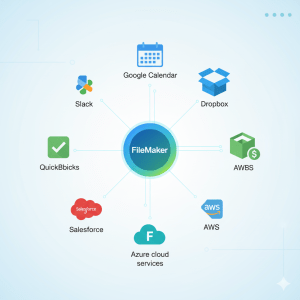
The Platform SDK plus Claris Connect makes it easier to automate workflows and connect FileMaker data to SaaS tools, CRMs, and cloud services. Developers can orchestrate processes without forcing users to leave their preferred UI, or can build headless backends that serve multiple frontends.
c) New toolchain & modern languages (JavaScript, Node-style runtimes)
Claris has been adding better JavaScript support and has updated runtime components (e.g., Node.js updates in FileMaker Cloud), signaling a trend: developers who add JS, REST, and modern toolchains will have an advantage when building extensions, custom web components, or client-side logic. Expect the SDK to encourage these languages/patterns.
d) AI and automation baked in
FileMaker 2025 releases explicitly surface AI features (AI script steps, LLM integrations, and AI-assisted workflows). The SDK will be a way to plug richer AI services into apps — for example preprocessing text, summarizing records, or generating responses for customer support flows. This lets developers augment apps with intelligent features without reworking the entire backend.
3) Concrete developer opportunities (use cases)
- Custom web dashboards: Build a React/Vue micro-frontend that reads/writes FileMaker data via the SDK/REST endpoints and embed it in Studio views for external users. (Great for catalogs, partner portals, and client-facing dashboards.)
- Headless FileMaker backends: Use FileMaker as the canonical datastore and expose REST endpoints for mobile apps or web apps built with modern frameworks.
- AI-enhanced automation: Add an LLM-based summarizer for long-form notes, or auto-tagging for records, via SDK connectors to external AI services.
- Integrations and automations: Orchestrate onboarding flows combining FileMaker data with payment gateways or CRMs using Claris Connect and platform SDK hooks.
- Custom plugins/extensions: Build reusable extensions (visual components, authentication adapters, or reporting engines) that other FileMaker teams can drop into their apps.
4) Technical implications — what to learn and why
High-impact technical skills to adopt:
- REST & GraphQL fundamentals — for building APIs and consuming external services.
- JavaScript (ES6+) & modern frameworks — necessary for custom web components, Studio views, and many SDK examples.
- Authentication & security (OAuth, JWT) — as apps become web-facing, secure token flows and role-based access are critical.
- Cloud architecture basics — containers, serverless concepts, and deployment models (since Claris Cloud and Studio blur the line between on-prem and cloud).
- Familiarity with Claris Connect and Claris Studio — these are now first-class citizens of the platform and often pair with SDK work.
- AI/LLM basics — prompt design, rate limits, and data privacy concerns if you’re integrating generative models.
5) Transition & migration recommendations for existing FileMaker projects
Short checklist for teams:
- Audit your solution: list which parts are internal-only vs. public-facing, and which workflows could be automated.
- Identify low-risk integration points: exports, scheduled scripts, reporting — these are good first targets.
- Prototype with Studio + SDK: start with a small web view for one module (e.g., an inventory dashboard) rather than rewriting the entire app.
- Design an API layer: use existing FileMaker data model but expose a versioned API so frontends can evolve independently.
- Security review: plan for authentication and data governance—especially if you integrate third-party AI services.
- Train your team: upskill at least one developer in JS and cloud patterns; the payoff for maintenance and innovation is large.
6) Challenges and realistic limitations
- Skill gap: Many traditional FileMaker developers are expert in low-code scripting and relationships but may need time to adopt JS, REST, and cloud concepts. Expect a learning curve.
- Complexity increase: A hybrid architecture (FileMaker + web frontends + integrations) is more powerful but also adds operational complexity: monitoring, logging, and deployment pipelines.
- Data governance & privacy: Adding web-facing endpoints and AI services increases the surface area for data leaks—careful design and compliance checks are required.
- Plugin/SDK stability: As Claris broadens the platform, early SDK versions may evolve quickly—plan for breaking changes and versioning strategy.
7) Tools, docs & places to learn (starter list)
- Official Claris platform pages & release notes — read the Platform and FileMaker 2025 release notes for exact SDK features and supported runtimes.
- Claris Community & backlog — product plans, community Q&A, and backlog items help you track upcoming SDK behavior.
- Third-party explainers & blogs (e.g., Datatherapy, Soliant) — practical guides and early adopter writeups that unpack new features and migration tips.
8) Roadmap: how to position yourself as a modern FileMaker developer
Short-term (0–3 months):
- Build a small prototype using Claris Studio to surface one FileMaker layout or list via a web view.
- Learn basic REST consumption/creation with a sample script.
Medium-term (3–9 months):
- Create a reusable integration (e.g., a connector to an external API or an LLM wrapper) using the SDK or existing REST hooks.
- Add CI/CD for your integrations and implement basic monitoring/logging.
Long-term (9–18 months):
- Offer hybrid solutions: FileMaker as the canonical datastore with micro-frontends or mobile apps built by you/your team.
- Teach/share knowledge internally or in the Claris community—there’s demand for expertise that spans both low-code and modern web stacks.
9) Final thoughts — the opportunity
The Claris Platform SDK turns FileMaker from a single-tool rapid app builder into a central component in a larger ecosystem. For developers who adapt—learning web technologies, API design, cloud principles, and AI basics—the SDK is a multiplier: it lets you deliver richer, more secure, and more scalable solutions while preserving FileMaker’s speed-to-value for business teams. The smart move today is to start small: prototype, learn, and gradually expand your toolset so you’re ready to take advantage of the platform’s new integrations and AI features.