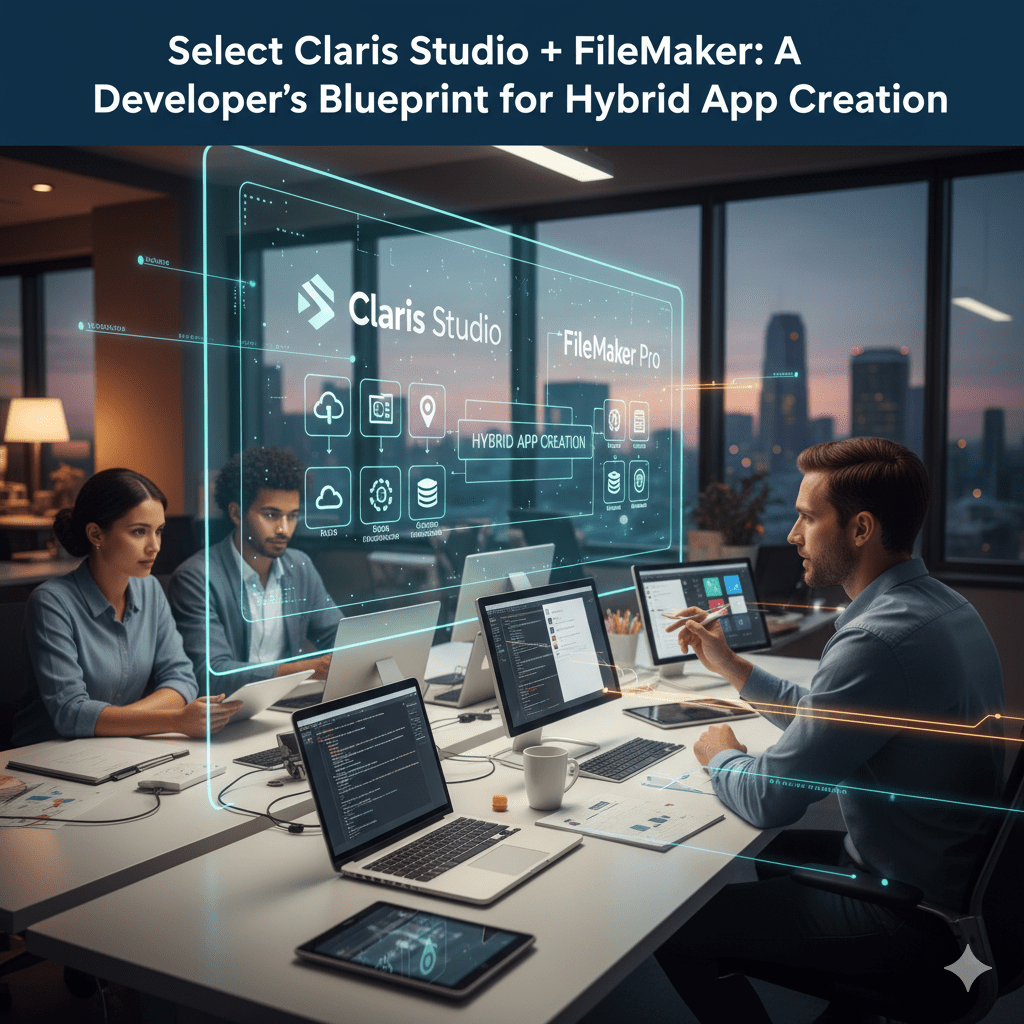
In recent years, Claris has been progressively evolving its ecosystem beyond the classic FileMaker desktop/workflow paradigm. With the introduction of Claris Studio, deeper integration with the Claris Platform, and the 2025 wave of AI and connectivity enhancements, developers are now empowered to build hybrid apps: solutions combining FileMaker’s strengths (data modeling, scripting, business logic) with web interfaces, external access, and more flexible user experiences.
The definition of hybrid in the Claris context, the new collaboration between FileMaker and Claris Studio, and an architecture, workflow, and best practices blueprint for creating hybrid apps using these tools will all be covered in this blog.
1. Why hybrid apps? The rationale
Before diving into architecture, let’s clarify why hybrid apps are now a compelling direction:
- Extend reach to web and external users: Many stakeholders (clients, partners, mobile users) expect browser-based or web-embedded interfaces rather than running a full FileMaker client.
- Leverage specialization: Use FileMaker for its strengths (data integrity, business logic, scripting) and use modern web or studio interfaces for UI/UX flexibility.
- Future-proofing: As the Claris platform evolves to support cross-tool workflows (Studio, Connect, APIs), hybrid design becomes more sustainable.
- Modular updates: UI layers, branding, or front-end logic evolve faster; by decoupling them from core logic, you can iterate UI without disturbing the backend.
Hybrid in the Claris world means that a portion of your app’s interaction surface can be via Claris Studio views or web interfaces that communicate with FileMaker behind the scenes, synchronizing data, executing logic, or serving as portals.
2. Recent updates that make hybrid apps possible (2023–2025)
Several key enhancements in Claris Studio and FileMaker now enable genuine hybrid integration. These are the building blocks behind the blueprint.
2.1 FileMaker–Studio data connectivity (bidirectional)
Recent releases introduced the ability for Claris Studio to connect to existing FileMaker tables (not just shadow or one-way reads). Now, with FileMaker 2025 (v22), hosted FileMaker apps can be surfaced through Studio views.
Key points:
- FileMaker Server must enable OData API, extended privileges must allow access, and SSL must be configured.
- Internal FileMaker accounts (non-external auth) are no longer supported for this connection, meaning external identity providers (OIDC, SAML, etc.) are required.
- When you create a FileMaker data source in Claris Studio, all fields from the table sync by default (you can’t yet choose a subset).
2.2 Automation and visibility logic in Studio
Studio has added an Automation tab for objects in views, letting developers define names, value conditions, or show/hide logic for UI elements.
This means user interface behavior (conditional visibility, dynamic UI) can be controlled directly in Studio, reducing the need to embed logic in the FileMaker layer for UI concerns.
2.3 Identity & embedding
Studio now supports external identity providers using OpenID Connect (OIDC) or SAML (e.g., Google Workspace, Okta, Microsoft Entra ID) for user authentication.
Studio forms (publicly shared) can now be embedded in external websites. That means portions of your hybrid app UI can live on your brand site and still feed into your Studio + FileMaker backend.
2.4 FileMaker server & AI enhancements
FileMaker Server 2025 introduces support for an AI Model Server, enabling open-source language models, retrieval augmented generation (RAG), model management, and APIs for AI interactions.
Also, FileMaker 2025’s “display and update FileMaker data via Claris Studio views” is explicitly supported in server releases.
Plus, FileMaker 2025 brings built-in AI script steps and functions (e.g., embeddings, semantic search) that can augment hybrid workflows.
2.5 Platform licensing & integration
Claris has made Studio and Connect more tightly packaged with FileMaker in the 2025 release, so more developers get access to these tools as part of their platform licensing.
These updates transform what was once experimental into first-class supported architecture for hybrid apps.
3. Hybrid app architecture blueprint
Below is a conceptual architecture and workflow you can use as a blueprint when designing hybrid apps with FileMaker + Studio.
┌──────────────────────┐        ┌───────────────────────┐
│ External Web / Portal │  ⟷   │ Claris Studio Views / UI │
└──────────────────────┘        └────────────┬───────────┘
                                           ▲
                                           │ Studio–FileMaker data sync (OData / API)
                                           ▼
                                ┌──────────────────────────────┐
                                │ FileMaker Server + Business Logic │
                                └──────────────┬──────────────────┘
                                               │
                               ┌───────────────┴──────────────┐
                               │ Integrations / Automation Layer │
                               └───────────────────────────────┘
Components & their roles
- External Web or Portal Layer
- Could be public sites, embedded views, or partner dashboards
- Embedded Studio forms or web components that talk to Studio APIs or data sources
- Claris Studio (View / UI Layer)
- Hosts views (forms, dashboards, list, detail) that connect directly to FileMaker tables
- Handles UI logic (visibility, conditional formatting, grouping)
- Authentication via external identity providers
- Can embed within external sites via iFrame/embed
- FileMaker Server + Business Logic Layer
- Core data model, relationships, scripting, validation, security
- Exposes tables via OData or API for Studio consumption
- Executes complex logic, triggers, workflows
- Hosts AI model server or connects to AI services
- Integrations / Automation / Middleware
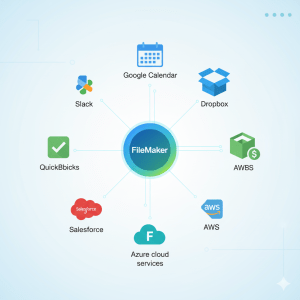
- Claris Connect, custom API endpoints, external services, webhooks
- Orchestrates cross-system workflows (e.g., pushing data to CRM, external apps)
- Handles data transformations
Data flow & sync patterns
- Read/Write Sync: Studio views connect to FileMaker tables and can update or fetch data live.
- Event-triggered logic: Actions in Studio (e.g. a user submits a form) trigger scripts in FileMaker to validate, compute, or cascade changes.
- Background or scheduled syncs: For batch jobs, external syncs, or data replication to other systems.
- AI augmentation: Business logic in FileMaker or integration layer can call AI endpoints, generate summaries, or feed semantic searches to Studio UI.
4. Step-by-step hybrid app creation plan
Here’s a phased plan to build a hybrid app combining Studio + FileMaker.
Phase 1: Planning & design
- Define your user personas (who uses web vs internal UI vs admin)
- Map data/open tables: Identify which FileMaker tables will be surfaced in Studio
- Design UI concepts in Studio (forms, dashboards)
- Define business logic boundary — what stays in FileMaker, what shifts to UI or automation
Phase 2: Setup & connectivity
- Ensure you’re on FileMaker 2025 (v22) on server and clients for full Studio integration.
- Enable OData API and configure extended privileges for relevant tables.
- Configure SSL certificate / identity provider (OIDC/SAML) for authentication.
- In Studio, add a FileMaker data source and connect the desired tables.
Phase 3: UI & interface building
- Build Studio views (forms, dashboards, lists) referencing the connected data
- Use Automation tab logic in Studio for conditional display / visibility
- Embed Studio forms/pages into external web portals where needed
Phase 4: Business logic & validation
- In FileMaker, write scripts and triggers to validate or enforce rules for submissions coming from Studio
- Setup AI or semantic search logic if needed—for example, summarizing long-form entries or auto-tagging text fields
- In integration layer (Claris Connect or custom APIs), orchestrate workflows that span FileMaker and external systems (CRM, email, etc.)
Phase 5: Testing & iteration
- Test synchronous updates (changes in Studio reflect in FileMaker and vice versa)
- Test edge cases, concurrency, data conflicts
- Optimize performance (data volumes, page loads, script speeds)
Phase 6: Deployment & monitoring
- Roll out access (user groups, permissions)
- Use monitoring/logging for errors or latency
- Plan iteration: as UI or workflow changes, update Studio views or logic without disrupting core data
5. Best practices & considerations
Security & permissions
- Always validate every request on the FileMaker side even if Studio is controlling visibility
- Use least privilege: only surface necessary tables/fields in Studio
- Handle concurrent edits and conflict resolution carefully
UI/UX consistency
- Maintain design consistency across Studio and external embeds
- Avoid overloading Studio with too many fields—consider summarization or filtered views
- Use conditional visibility rather than duplicate layouts
Performance
- Keep Studio queries light — avoid very large tables unless paginated
- Use indexing, filtered portals, and optimized script logic
- Be mindful of network latency and caching strategies
Versioning & backwards compatibility
- Stay aware of Claris updates—Studio or FileMaker changes might affect APIs or connectivity
- Plan for fallback or read-only modes if connectivity drops
Hybrid mindset
- Don’t try to replicate every FileMaker layout in Studio—pick the parts that benefit from web or external exposure
- Use Studio primarily for presentation, input, dashboards; keep complex logic centralized
- Iterate UI layer quicker than core logic
6. Example use case: Customer Portal + Admin Dashboard hybrid app
Imagine a company using FileMaker for order fulfillment. They want a customer-facing portal and an internal admin dashboard:
- Customer portal (web): Uses embedded Studio forms and views where customers can view orders, submit support tickets, or update contact info.
- Claris Studio (internal UI): Internal staff see advanced dashboards of orders, KPIs, fulfillment status, can approve returns, etc.
- FileMaker (backend): Holds orders, inventory, pricing logic, scripts for validation, triggers for notifications.
- Integrations: On order submission, Claris Connect pushes confirmation emails, updates a CRM, or triggers shipping APIs.
- AI assistance: Use AI scripts to classify support tickets, suggest responses from past data, or summarize customer messages.
This architecture lets customers interact via web without needing FileMaker license; internal users retain the full power of FileMaker + Studio.
7. Challenges & things to watch
- Field-level sync flexibility is limited: right now you can’t choose to sync only selected fields; all fields propagate. (Claris plans to improve this)
- Authentication complexity: moving away from internal accounts means extra setup and dependency on IdP reliability.
- Schema changes caution: if you alter FileMaker tables (add, delete fields), you need to account for synchronization in Studio.
- Performance at scale: very large data sets or heavy usage might strain the sync or API layers.
- Breaking changes risk: new Claris updates may change Studio–FileMaker interaction behavior—keep eye on release notes.
8. What to learn as a developer to thrive in hybrid Claris development
- Deep understanding of OData / REST / JSON
- Familiarity with identity protocols (OIDC, SAML)
- UI design and conditional logic in Studio
- FileMaker scripting, triggers, and validation best practices
- Integration/automation skills, e.g. Claris Connect, webhooks, API orchestration
- AI / semantic search skills to embed intelligent features
- Performance optimization and schema versioning strategies
Conclusion
The integration of Claris Studio + FileMaker marks a turning point in how developers can build hybrid applications that combine internal, secure logic with external, web-accessible interfaces. The tools and updates currently in Claris 2025 make this a viable, supported architecture—not just a workaround.
For developers, the path forward is clear: master connectivity, embrace hybrid UI design, modularize logic, and build for flexibility. If you adopt this blueprint, you’ll be well prepared to deliver next-generation apps in the expanding Claris ecosystem.