In traditional software development, Quality Assurance (QA) often depends on external testing frameworks, automation suites, or third-party integrations. But in Claris FileMaker, things work a little differently.
Because FileMaker applications are often custom-built, rapidly deployed, and business-specific, developers need QA processes that are lightweight, flexible, and native. The good news? You can achieve robust testing — without leaving FileMaker at all.
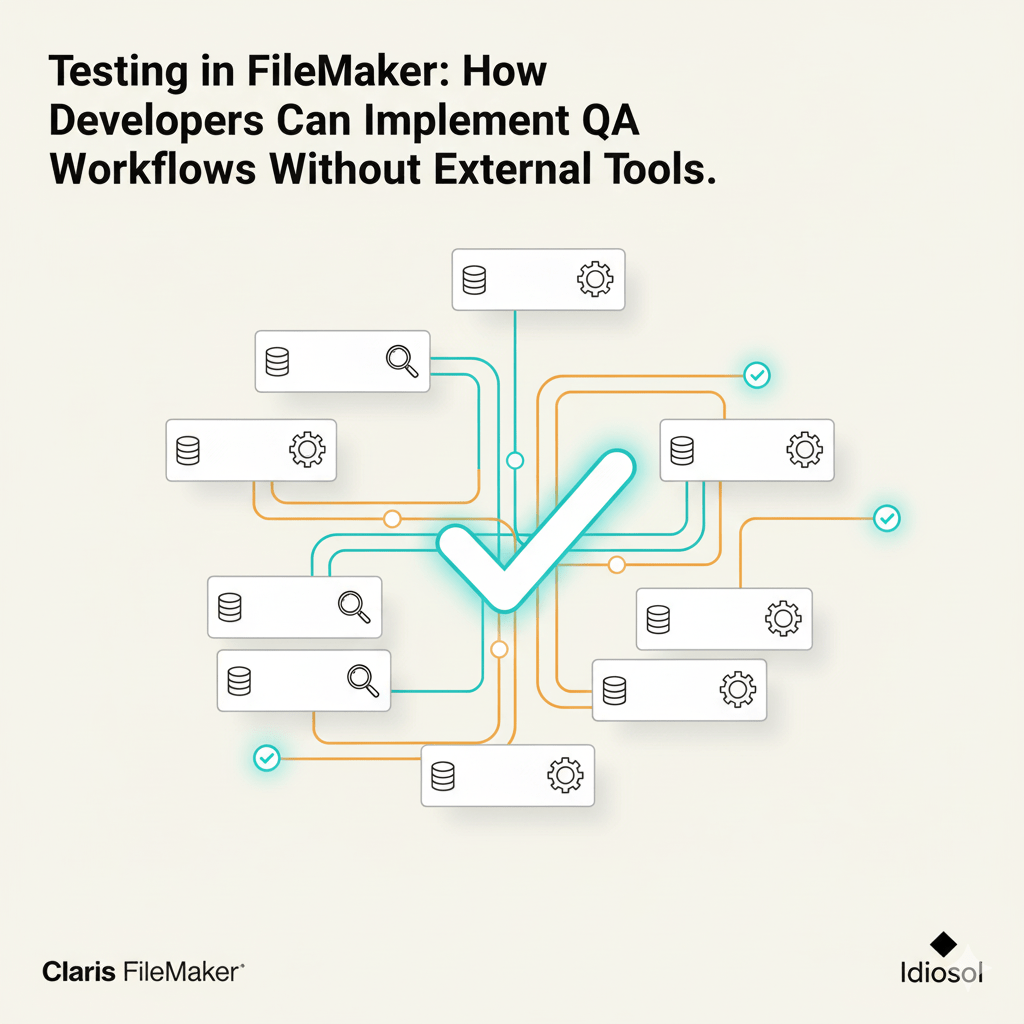
This post explores how FileMaker developers can design QA workflows inside their own apps, ensuring stability and performance from prototype to production.
Why QA Matters in FileMaker Development
When you’re building tailored business apps, every script, layout, and relationship matters.
Without consistent testing, you risk:
- Script errors in edge cases
- Misaligned layouts or data inconsistencies
- Workflow bottlenecks that affect user trust
- Regression bugs after version updates
Unlike traditional web apps, FileMaker solutions are often mission-critical — used daily by operations teams. That means even small issues can lead to downtime or data errors.
A structured QA workflow can catch problems before they impact real users.
Step 1: Build a Dedicated “Test” Mode in FileMaker
Start by creating a QA layout or mode that mirrors your production environment but isolates testing behavior.
This can include:
- Test data sets: sample records that simulate real workflows.
- Conditional visibility: hide or show debug panels based on a “QA Mode” global variable.
- Script flags: define a global variable (like
$$isTesting = 1) to activate logging or bypass certain user interactions.
This approach keeps your testing environment self-contained and prevents interference with live data.
Step 2: Automate Script Testing with Custom Logs
You can use FileMaker scripts and custom tables to track and verify QA results.
Here’s how:
- Create a “Test Results” table with fields like
TestName,ExpectedResult,ActualResult,Status, andTimestamp. - Write a script that executes target functions and automatically logs results in this table.
- Display pass/fail reports using conditional formatting (green = pass, red = fail).
This mimics basic unit testing — built right into FileMaker’s scripting engine.
💡 Pro tip: Combine script triggers (OnFirstWindowOpen, OnLayoutEnter, etc.) with your QA mode to auto-run tests during development sessions.
Step 3: Validate Data and Business Logic
Use FileMaker’s calculation fields, custom functions, and error capture to automatically verify data integrity.
Examples:
- Use
Get(LastError)to detect issues during record creation or update. - Implement validation rules at the field level to catch inconsistent data.
- Add conditional scripts that alert testers when calculations deviate from expected logic.
This approach ensures every layer of your app — from interface to backend — adheres to consistent standards.
Step 4: Version Control Through Comments and Audit Logs
Even without Git integrations, you can maintain traceability within FileMaker by:
- Using comment blocks in scripts for version notes and QA status.
- Creating an Audit Log table to record user and developer changes.
- Saving snapshots of layouts or scripts before major updates.
This makes rollback and comparison easy — and gives your QA workflow transparency.
Step 5: Involve Users in QA Feedback
One of FileMaker’s greatest strengths is how close it brings developers to end-users.
Create a “Feedback” layout where testers or business users can:
- Submit bug reports directly.
- Attach screenshots or describe replication steps.
- Automatically log context (layout name, timestamp, user account).
This feedback loop ensures continuous improvement — without relying on external ticketing systems.
Bonus: Automate Regression Testing
You can simulate regression testing by storing expected vs. actual outcomes in your Test Results table.
Whenever a script or calculation changes, simply re-run all QA scripts — and instantly see if any prior tests fail.
This makes your FileMaker QA process repeatable and scalable.
Conclusion
Expensive or sophisticated tools are not necessary for testing.
Developers of Claris FileMaker can create a comprehensive QA system that is lightweight, adaptable, and completely in line with their business logic with a little preparation.
At idiosol, our developers build not just smart FileMaker solutions but also resilient QA frameworks that ensure long-term reliability and client satisfaction. Because the best systems aren’t just built fast — they’re built to last.