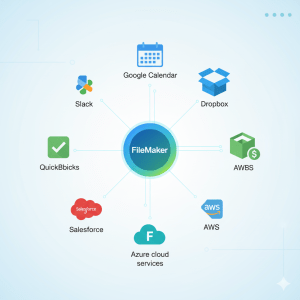
In a world where success is determined by speed and clarity, companies require linked systems rather than discrete tools.
A robust low-code platform called Claris FileMaker assists businesses in automating, managing, and analyzing data-driven procedures. In contrast, Asana is a pioneer in task and project management, maintaining team cohesion and organization.
FileMaker and Asana integration allows you to convert static data into real-time collaboration and quantifiable progress, bridging the gap between structured data and actionable project execution.
Why Integrate FileMaker with Asana?
Both platforms are exceptional on their own — but when connected, they create a seamless loop between data management and team execution.
Here’s why integration matters:
- Eliminate manual data entry: Automatically sync records, tasks, and updates between systems.
- Improve project visibility: Centralize task data and performance metrics for better decision-making.
- Enhance coordination: Link operational data from FileMaker to Asana’s real-time task tracking.
- Automate repetitive workflows: Trigger actions, notifications, or updates without manual intervention.
- Maintain control: Keep FileMaker’s security and permissions intact while sharing relevant data in Asana.
Imagine this: a client order is added in FileMaker — instantly, a new Asana task is created for the delivery team, deadlines are set, and updates flow both ways. No copy-pasting, no miscommunication — just clean, automated workflow.
How FileMaker–Asana Integration Works
The integration can be achieved through several modern approaches depending on your technical expertise and business needs.
1️⃣ Claris Connect (No-Code/Low-Code Integration)
Claris Connect — part of the Claris ecosystem — offers a simple, visual way to integrate FileMaker with third-party apps like Asana.
Use cases include:
- When a new record (e.g., project, lead, or order) is created in FileMaker, automatically create a task in Asana.
- When a task’s status changes in Asana, update the corresponding record in FileMaker.
- Send automated notifications in Asana when FileMaker fields like “Due Date” or “Priority” are updated.
How it works:
- Create a Claris Connect flow.
- Set FileMaker as the trigger (e.g., “New Record Added”).
- Add an Asana action (e.g., “Create Task” or “Update Task”).
- Authenticate both apps securely and test the workflow.
No heavy coding required — it’s all drag-and-drop automation.
2️⃣ Using Asana’s API and FileMaker’s Data API
For businesses that need more control and customization, connecting via APIs provides deeper flexibility.
Example workflow:
- FileMaker’s Data API extracts structured data (like project details, clients, or time logs).
- This data is sent via an HTTP request to Asana’s REST API, which automatically creates or updates tasks, subtasks, or comments.
- Responses from Asana can be parsed back into FileMaker, updating statuses or task completion data.
Use cases:
- Automatically create Asana projects for new clients or jobs in FileMaker.
- Update task progress in FileMaker when Asana users mark items complete.
- Generate dashboards inside FileMaker using live data from Asana’s API.
This method is perfect for organizations that already have a developer or IT team managing API endpoints.
3️⃣ Third-Party Integration Platforms (Zapier, Make/Integromat, etc.)
If you prefer a more flexible integration without direct API scripting, Zapier, Make (formerly Integromat), or n8n.io can serve as powerful middle layers.
Example “Zaps” or Scenarios:
- “When a new task is created in Asana → create a new record in FileMaker.”
- “When a FileMaker record is updated → update an Asana project or tag.”
- “When a milestone is reached in FileMaker → send a status update to Asana.”
These platforms also allow conditional logic, filters, and multi-step workflows — letting you design integrations tailored to your team’s operations.
Key Benefits of FileMaker–Asana Integration
| Benefit | Description |
|---|---|
| Unified Data Flow | No more switching between platforms — everything stays synchronized. |
| Enhanced Team Collaboration | Project tasks automatically align with database records. |
| Fewer Errors | Automated sync reduces manual input and potential mistakes. |
| Time Savings | Teams focus on execution, not data management. |
| Informed Decisions | Real-time insights from both systems lead to smarter planning. |
Real-World Example: Streamlined Project Tracking
Scenario:
A construction firm manages project data — like site details, budgets, and progress — in FileMaker.
Challenge:
Their operations team uses Asana to track tasks, deadlines, and communication, but manually copying data led to delays and inconsistencies.
Solution:
They set up a Claris Connect workflow that:
- Automatically creates an Asana project when a new construction project is added in FileMaker.
- Syncs progress updates back to FileMaker for management reports.
- Sends daily task summaries via email using both Asana and FileMaker data.
Result:
⏱ 40% less manual work
📊 Unified reporting between systems
💬 Faster team alignment across departments
Best Practices for a Smooth Integration
- Define clear sync rules — Avoid duplication by deciding which system owns which data.
- Use naming conventions — Keep project and task names consistent across systems.
- Test your flows — Run pilot workflows before full deployment.
- Monitor API limits — Especially when using large datasets or frequent updates.
- Secure your data — Always use encrypted connections (HTTPS) and limited-access tokens.
Future of FileMaker–Asana Integration
As organizations embrace low-code and cloud-native systems, interoperability becomes the backbone of digital productivity.
Both Claris FileMaker and Asana are continuously evolving — FileMaker with enhanced Claris Studio and Connect capabilities, and Asana with AI-powered workflow management and advanced automation.
Integrating them ensures your teams don’t just collect data — they act on it instantly.
Conclusion: From Insight to Execution
Integrating FileMaker with Asana empowers organizations to turn data into direction and projects into progress.
When your operational systems (FileMaker) and task management tools (Asana) work together, your teams gain clarity, efficiency, and speed — all without friction.
Whether you use Claris Connect, APIs, or third-party automation platforms, this integration ensures one thing:
✅ Everyone is on the same page — and everything moves forward.