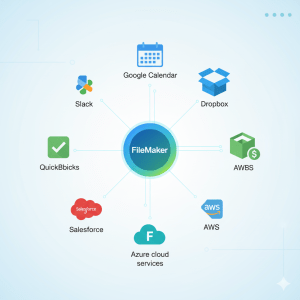
Integrating Claris FileMaker with modern tools—APIs, webhooks and cloud services—is no longer optional; it’s essential for building scalable, connected business solutions. FileMaker’s core strength has always been rapid application development, and when you pair that with external integrations you unlock enterprise‑level connectivity without compromising agility. In this post, we’ll explore how FileMaker can integrate with modern systems, what the best practices are in 2025, and how you as a developer can make it happen.
APIs: The Gateway to External Systems
FileMaker supports the Data API (REST/JSON) which enables create, read, update and delete operations via HTTP. You enable the “fmrest” extended privilege, then POST to /fmi/data/vLatest/databases/YourDB/sessions to obtain a session token. From there you can call endpoints like /_find, /_layouts/{layout}/records, /_scripts/{scriptName} to execute scripting logic remotely. Using APIs means FileMaker becomes a backend service for web, mobile or cloud‑apps. APIs are ideal for scheduled tasks, bulk imports/exports, or exposing business logic to other tools.
Webhooks: Real‑Time Events & Listening Endpoints
Webhooks flip the model: instead of FileMaker polling, external systems push event data into FileMaker in real‑time. For example, when a payment gateway verifies a transaction, it calls a webhook URL you’ve configured, and your FileMaker application immediately updates the record status. Within the Claris ecosystem, the Claris Connect product supports native webhook triggers: you can create a webhook URL in Connect, link it to a flow, then in FileMaker trigger a script via the “Trigger Claris Connect Flow” script step (introduced in FileMaker 20.2) to simplify the process. Webhooks are ideal for notifications, IoT events, chatbots, third‑party service callbacks, and any scenario where you need an immediate response.
Cloud Services & Hybrid Architecture
Modern solutions often leverage cloud services—hosting FileMaker Server in the cloud, using cloud‑based microservices, or integrating with SaaS platforms like Shopify or Xero. FileMaker can act as both the orchestrator and data store: you might receive events via webhook, push data via API, or call cloud functions via Insert From URL / cURL. For example, webhooks from e‑commerce services (Shopify, WooCommerce) can push new order data into FileMaker using Claris Connect or custom middleware.
Best Practices for Developers
• Use secure authentication: when calling APIs or webhooks, use API keys, OAuth tokens and secure endpoints. • Design for failure: expect network or third‑party downtime; implement retry logic and error logging. • Offload heavy processing: use server‑side scripts or scheduled tasks rather than client‑side loops. • Avoid polling when possible: webhooks are more efficient for event‑driven systems. • Model your data and relationships with scalability in mind: flattened graphs, indexed fields and efficient layouts matter even more in integrated apps.
Example Workflow
- External system triggers an event (e.g., a payment confirmed).
- That system calls a webhook URL created in Claris Connect.
- Claris Connect flow receives the payload, transforms JSON if needed, then triggers FileMaker via Data API or directly.
- FileMaker runs a script to update records, run business logic, notify users or send follow‑up via API.
- FileMaker might call another cloud service, write to audit log, or queue tasks for later processing.
Conclusion
Today’s FileMaker developers must integrate with cloud services, webhooks, and APIs in order to create intelligent, networked business apps. You create ecosystems rather than discrete databases. Adopting cloud connectivity and real-time events increases responsiveness, allows for confident scaling, and produces solutions that satisfy contemporary demands. When designing your next FileMaker project, consider integration, automation, and data flow between systems rather than just layouts and fields.