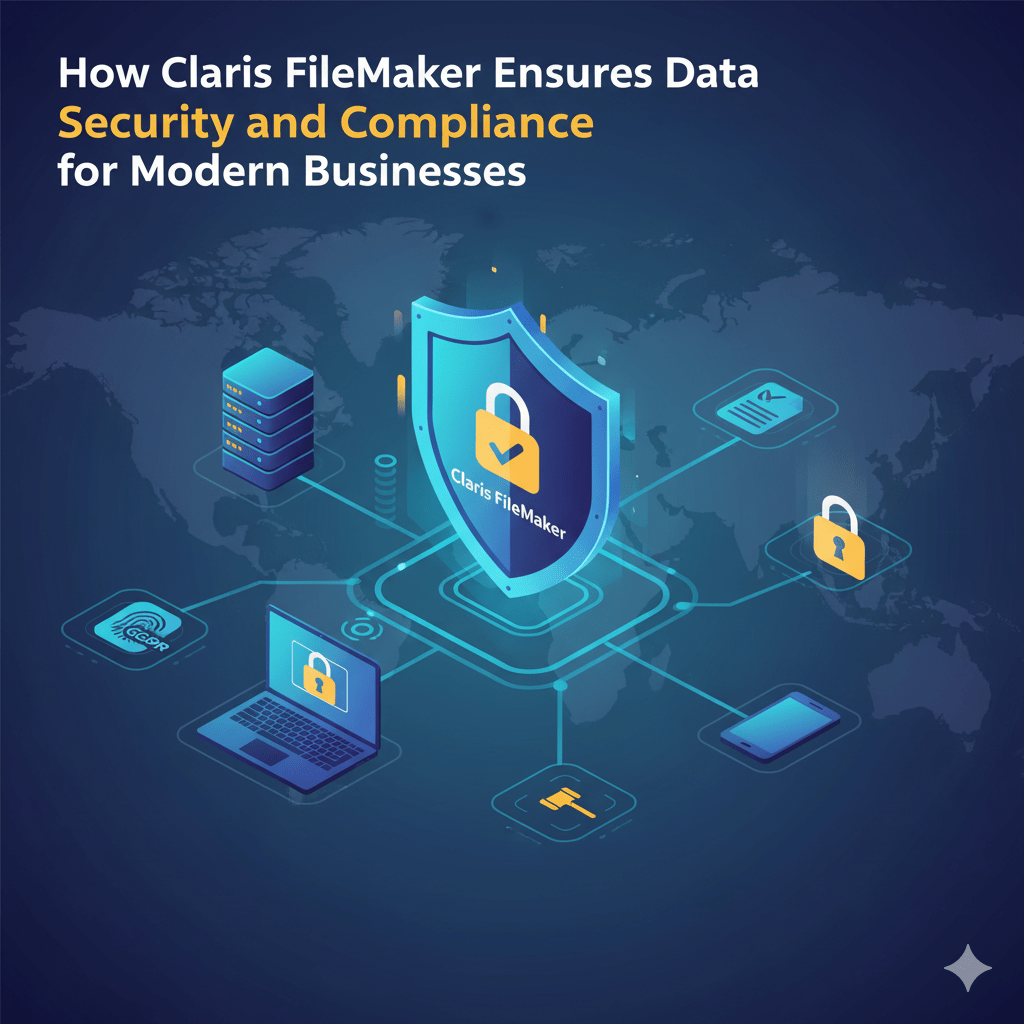
There has never been a more pressing need for secure application platforms in a world where headlines are dominated by data breaches and regulatory fines. Claris FileMaker is a platform designed with enterprise-grade security and compliance in mind, in addition to being a fast application development tool. We’ll go over how FileMaker meets the security requirements of contemporary businesses, what developers should concentrate on, and how to incorporate best practices into your solutions below.
Enterprise‑grade Security and Compliance Credentials
Claris operates under rigorous security standards: their cloud services have achieved SOC 2 Type 2 attestation and ISO/IEC 27001 & ISO/IEC 27018 certifications for information security and personal data in the cloud. These certifications provide independent validation that controls around confidentiality, availability and security are designed and operating effectively.
Encryption & Data Protection
FileMaker’s security architecture includes encryption of data both at rest and in transit. Data stored on disk is protected using AES‑256 encryption and network communication uses TLS/SSL (TLS 1.2 or greater). This means even if storage media is compromised, the data remains unreadable without appropriate keys. For in‑transit data, the secure channel prevents interception or tampering.
Authentication, Access Control & Privilege Sets
On the developer side, FileMaker supports flexible authentication models: internal accounts, external identity providers (Active Directory, OAuth 2.0) as well as multi‑factor authentication (MFA). Privilege sets and account‑based security let you define exactly what each user (or group) can view, edit, delete, or export. You can restrict access to layouts, fields, scripts, export/print commands, and even schema changes. This level of granularity is critical for maintaining least‑privilege access across users and business roles.
Deployment Controls & Monitoring
When solutions are hosted on FileMaker Server or FileMaker Cloud, administrators have tools to monitor usage, manage connections, run backups, and enforce secure configurations. In FileMaker Cloud, the Claris Customer Console lets team managers control users, groups and subscription settings. Regular logging and audit trails are supported, enabling detection of suspicious activities and supporting compliance efforts.
Regulatory Compliance in Your Solution
It’s not just the platform that secures data—it’s how you design your solution. FileMaker supports compliance for many regulatory standards when correctly configured:
- Require SSL/TLS for all connections, ensuring encryption in transit.
- Use external authentication and enforce strong password standards and MFA when needed.
- Build audit‑logging tables or use plug‑ins to capture user actions and changes, satisfying audit trail requirements.
- Archive or delete data per retention policies. The platform supports data retention and deletion in accordance with privacy regimes.
Designing with compliance in mind means more than using FileMaker’s features—it means aligning with your organisation’s regulatory requirements (GDPR, NIST, COBIT, etc.).
Developer Best Practices
To maximise the security and compliance benefits of FileMaker, developers should adopt these practices:
- Keep the FileMaker platform and server software up to date—security patches and improved protocols are delivered with new releases.
- Limit administrative access and avoid embedding sensitive credentials in scripts. Use environment variables or secure configurations.
- Use encrypted hosted files; enable encryption for new databases and ensure backup files are also protected.
- Define clear privilege sets and test them from a non‑admin account to verify restrictions.
- Configure logging for critical changes and review them periodically.
- If handling especially sensitive data (e.g., personal health information), ensure your solution design aligns with required certifications—even if the platform does not explicitly certify for HIPAA, you can use the built‑in tools to model compliant behaviour.
Conclusion
For modern businesses building custom applications, the choice of development platform must include security, compliance and scalability considerations. Claris FileMaker delivers not only rapid development but also a strong foundation of encryption, access control, deployment management and auditability. For developers and solution architects, your role is to leverage these mechanisms wisely and design each solution with both functionality and risk‑mitigation in mind. Ensuring your data is secured, your access is controlled and your processes are auditable will position your FileMaker app as a trusted asset—not a liability—in today’s data‑driven business environment.