Global business operations have changed as a result of the growth of remote work. In order to sustain productivity, distributed teams now need tools that are safe, effective, and collaborative. Claris FileMaker has become a flexible platform to satisfy these needs. Teams can work together seamlessly from any location using FileMaker’s low-code development, cloud accessibility, and real-time collaboration features.
Cloud-First Collaboration
FileMaker Cloud and FileMaker Server allow teams to access centralized databases in real-time. With secure connections via TLS/SSL encryption, team members can update records, run scripts, and collaborate on workflows without the limitations of location. Cloud-hosted FileMaker solutions reduce the dependency on physical servers, simplify deployment, and ensure business continuity for distributed teams.
Real-Time Access Across Devices
Modern FileMaker solutions support multiple clients accessing the same data simultaneously. Whether using FileMaker Pro on a laptop, FileMaker Go on iOS, or FileMaker WebDirect in a browser, all users see updates instantly. Developers can design layouts optimized for each device, ensuring a consistent and responsive user experience across platforms, which is essential for maintaining productivity in remote teams.
Automated Workflows and Task Management
FileMaker’s scripting engine and automation capabilities allow teams to automate repetitive tasks, assign workflows, and trigger notifications. For example, a FileMaker app can notify team members when a record is updated, a project milestone is reached, or a task requires attention. Automation reduces communication delays common in remote setups and ensures everyone stays aligned with project goals.
Integration with Modern Tools
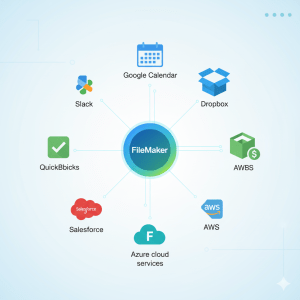
FileMaker integrates with cloud services, APIs, and webhooks, enabling distributed teams to connect with tools like Slack, Microsoft Teams, Trello, and project management platforms. Real-time integrations allow teams to receive updates and act on data without leaving their FileMaker environment, bridging gaps between remote workflows and external systems.
Security and Compliance for Remote Teams
Secure remote collaboration requires strict access controls and data protection. FileMaker provides granular privilege sets, external authentication via OAuth or Active Directory, and support for multi-factor authentication. Audit logs and encrypted backups ensure that all team activity is monitored and sensitive information remains protected, even in a distributed environment.
Developer Best Practices for Remote Collaboration
- Optimize layouts for performance across networks to reduce latency for remote users.
- Use server-side scripts (Perform Script on Server) for heavy tasks to minimize client load.
- Implement offline capabilities where possible using local caches or synchronization strategies.
- Monitor usage and connection logs to identify bottlenecks or performance issues for remote clients.
Conclusion
FileMaker enables distributed teams to collaborate efficiently by combining real-time data access, cross-device support, secure cloud deployment, and powerful automation. For businesses embracing remote work, FileMaker is more than a database—it is a central hub for productivity, coordination, and team success. As remote work continues to expand globally, leveraging FileMaker’s capabilities ensures teams remain connected, informed, and efficient no matter where they are.