In today’s business environment, simply automating tasks isn’t enough. The winners aren’t just those tearing out manual processes—they’re the ones whose systems adapt, evolve and anticipate. That’s where Claris FileMaker developers step in: not just automators, but architects of self-evolving digital ecosystems.
Why “automation” is only the beginning
Automation is valuable—it reduces manual work, increases consistency, and frees up time. But if your solution stops there, you’re still playing catch up. For instance:
- A workflow automates invoice generation → but doesn’t adapt when new product lines, tax rules or regions are added.
- A system sends alerts → yet the logic is fixed and cannot learn from patterns or optimise itself.
What businesses need now is a system that doesn’t just execute commands—it learns, adapts, and expands as new needs emerge.
What is a self-evolving system?
A self-evolving system is one that:
- Reacts intelligently to change (e.g., business rules, user behavior, external data)
- Scales without rewriting the core every time a process changes
- Integrates seamlessly with new services and workflows
- Embeds feedback loops and analytics so the system improves over time
In the context of FileMaker, a self-evolving system means developers build solutions where the architecture supports growth, integration, and adaptation—not just workflow automation.
How Claris Developers Create These Systems
1. Modular, reusable architecture
Instead of one monolithic solution, FileMaker developers design modules: reusable script libraries, standardized layouts, and flexible tables. When new requirements arrive, modules are updated or added—rather than rebuilding the system. This modularity ensures future adaptability.
2. Smart integration & data flow
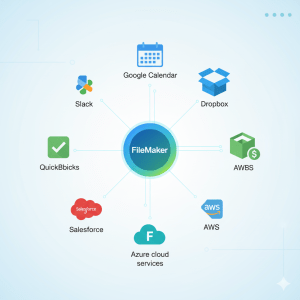
Self-evolving systems don’t sit alone. They connect. Claris developers integrate FileMaker with external services, APIs, cloud workflows, and other data sources. By keeping the system open and connected, the platform can evolve as new tools or partnerships surface.
3. Real-time analytics & feedback
One key difference: developers embed analytics not only to report, but to drive system behaviour. When patterns emerge (customer behavior changes, process bottlenecks appear) the system can flag or adjust logic accordingly—helping the business respond faster.
4. Flexible user interfaces
As business users adopt more mobile, remote, diverse workflows, the UI must adapt. FileMaker developers deliver interfaces that can evolve—for different devices, roles, and use-cases—without rewriting the core logic each time.
5. Low-code for speed + pro-code for depth
FileMaker’s low-code nature is a strength—it lets developers rapidly build and iterate. But smart developers also leverage pro-code hooks, API layers, and integration readiness to ensure the system can handle existential changes in business. This dual approach is what allows self-evolving systems to keep pace.
Why this matters to your business
- Future-proof investment: A system that evolves helps avoid complete re-builds every time business changes.
- Agility = competitive edge: When you can adapt workflows, integrate new data sources or pivot operations quickly, you’re ahead of rivals locked in legacy systems.
- Better ROI: Instead of spending large amounts on one-off projects, the system becomes a living asset that keeps delivering.
- Scalable architecture: Growth doesn’t require replacing the base platform—it builds on it.
- Reduced risk: Because the system is designed for change, entering new markets, adding new products or adjusting to regulations becomes smoother.
Real-world examples
- A manufacturing firm used FileMaker to automate inventory—then added IoT sensor integration, real-time quality checks and dashboards without rebuilding from scratch.
- A services company built a client portal. When customer demands shifted, the portal’s modules were extended, interfaces updated, and processes changed—all while the core FileMaker logic stayed intact.
The role of the Claris developer in this era
Claris developers are no longer just builders—they’re strategic partners. They:
- Understand business workflows deeply
- Architect systems for change, not just tasks
- Leverage FileMaker’s flexibility and extend it with integrations
- Equip businesses with platforms that evolve, not expire
Getting started: 5 tips to design self-evolving systems with FileMaker
- Audit current workflows and identify change-points (where things change often)
- Design modular components instead of one big solution
- Plan integration points early (APIs, data sources, cloud services)
- Embed feedback loops (analytics, usage metrics, adaptability triggers)
- Use FileMaker’s latest version and features (such as AI integration, cloud support) to maximise longevity
Conclusion
Your digital systems need to be able to grow, learn, and adapt in a world that is constantly changing. You can create a system that not only supports your company now but also changes with it in the future with Claris FileMaker and an innovative development team.