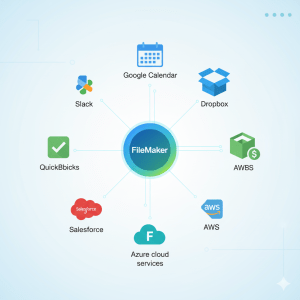
If properly constructed, a FileMaker system can serve as the foundation of your company. Many businesses begin with a simple configuration, gradually add features, or depend on developers who are not truly proficient with FileMaker. The outcome? Workflow issues, security threats, slow performance, and irate users.
In order to provide businesses with a high-performing, secure, and scalable solution, we break down the most frequent errors in FileMaker systems in this blog and explain how our team finds, fixes, and optimizes them.
1) Poor Data Structure (The Silent Killer of Performance)
The mistake:
Many FileMaker systems grow without planning. Tables aren’t normalized, fields are duplicated, and relationships become messy. Over time, this leads to:
- Slow layouts
- Inaccurate reporting
- Duplicate records
- Difficult maintenance
- Errors that spread across the system
How our team fixes it:
We rebuild data architecture using FileMaker best practices:
✔ Normalized tables
✔ Clean relationships
✔ Primary keys + foreign keys
✔ Consistent naming conventions
✔ Efficient indexing
Result: Your system becomes faster, cleaner, and far easier to maintain.
2) Slow Layouts and Heavy Screens
The mistake:
Layouts overloaded with portals, unstored calculations, conditional formatting, or unnecessary objects make the system lag — especially for remote users.
How we fix it:
We redesign layouts for speed:
✔ Remove heavy calculations from layouts
✔ Use server-side scripts instead of client-side calculations
✔ Optimize conditional formatting
✔ Reduce portal load
✔ Cache data intelligently
Your screens load in seconds — even with hundreds of records.
3) Scripts That Break or Take Too Long
The mistake:
Scripts often evolve without planning. Developers patch instead of optimize. The result:
- “Spinning wheel” delays
- Scripts that break when data grows
- Hard-to-read logic
- No error handling
How we fix it:
We rewrite scripts using modern FileMaker standards:
✔ Modular scripting
✔ Error trapping
✔ Clear logic
✔ Server-side execution
✔ Optimized loops and finds
After optimization, processes that took minutes run in seconds.
4) Inefficient Reporting and Dashboard Calculations
The mistake:
Businesses rely on reports, but many FileMaker systems calculate data on the fly — causing huge performance issues.
How we fix it:
We build intelligent reporting systems:
✔ Summary tables
✔ Pre-calculated values
✔ Server-side reporting scripts
✔ Optimized finds
✔ Lightweight dashboards
Result: Instant insights instead of time-consuming load times.
5) Weak Security and Access Control
The mistake:
Many systems have overly open privilege sets, weak passwords, no audit trail, and poorly configured layouts. This exposes business data to accidental or intentional misuse.
How we fix it:
Our security overhaul includes:
✔ Role-based access
✔ Encrypted data-at-rest
✔ Strict privilege sets
✔ Record-level restrictions
✔ Custom login experience
✔ Audit logs and change history
Your system becomes secure, compliant, and professionally protected.
6) No Documentation or Coding Standards
The mistake:
If a developer leaves the company, no one knows:
- Why things were built a certain way
- What scripts do
- Which layouts are used
- How relationships connect
- Where data flows
This leads to chaos when updates are needed.
How we fix it:
We document everything:
✔ Script explanations
✔ Relationship diagrams
✔ Naming conventions
✔ Layout lists
✔ System flow charts
Any developer can understand your system instantly.
7) Unstable Integrations (APIs, Web Hooks, Accounting, Shopify, etc.)
The mistake:
Integrations often work… until one tiny change breaks everything. Many systems rely on unstable scripts, unhandled errors, or outdated API calls.
How we fix it:
We rebuild integrations with:
✔ Stable API endpoints
✔ Error-proof scripts
✔ JSON handling
✔ Webhooks
✔ Sync logs
✔ Retry logic
You get reliable, real-time data flow between all your business tools.
8) Using FileMaker Like Excel (The Biggest Beginner Mistake)
The mistake:
People new to FileMaker often treat it like spreadsheets: one table, many fields, no structure. This causes:
- Bloated layouts
- Slow queries
- Messy data
- Hard-to-scale processes
How we fix it:
We migrate systems from “Excel-thinking” to proper database design — giving you a powerful, efficient, scalable solution.
9) No Backup or Data Recovery Plan
The mistake:
Many businesses discover the importance of backups only when something goes wrong.
How we fix it:
We implement:
✔ Automated backups
✔ Off-site backup storage
✔ Scheduled verification
✔ Point-in-time recovery
✔ Disaster recovery plan
Your data becomes safe and recoverable — no matter what.
10) Systems That Don’t Scale With Growth
The mistake:
FileMaker solutions often start small, but as your business grows, your system starts breaking.
How we fix it:
We design scalable systems with:
✔ Efficient queries
✔ Proper indexing
✔ Modular architecture
✔ Server-side processing
✔ Optimized relational design
Your system grows with your business, not against it.
How Our Team Transforms Broken FileMaker Systems Into Powerful Business Tools
Here’s our process for fixing any FileMaker solution:
1. Audit & Diagnosis
We scan your entire system to identify performance, security, and structural issues.
2. Optimization Plan
You get a clear roadmap: what’s broken, why, and how we’ll fix it.
3. High-Impact Fixes First
We target issues that deliver immediate improvements.
4. Modernization & Enhancements
We rebuild scripts, layouts, integrations, and security.
5. Testing & Quality Assurance
Everything is tested for speed, reliability, and stability.
6. Deployment & Training
We ensure your team understands the new features and workflows.
7. Ongoing Support
We keep your system healthy, updated, and future-proof.
Final Thoughts: Small Mistakes Become Big Costs — Unless Fixed Professionally
Most FileMaker issues start small but grow into major problems:
- Staff wasting hours
- Broken workflows
- Wrong data
- Slow reporting
- Security risks
Our team specializes in turning outdated or poorly built FileMaker systems into fast, stable, modern, business-boosting platforms.