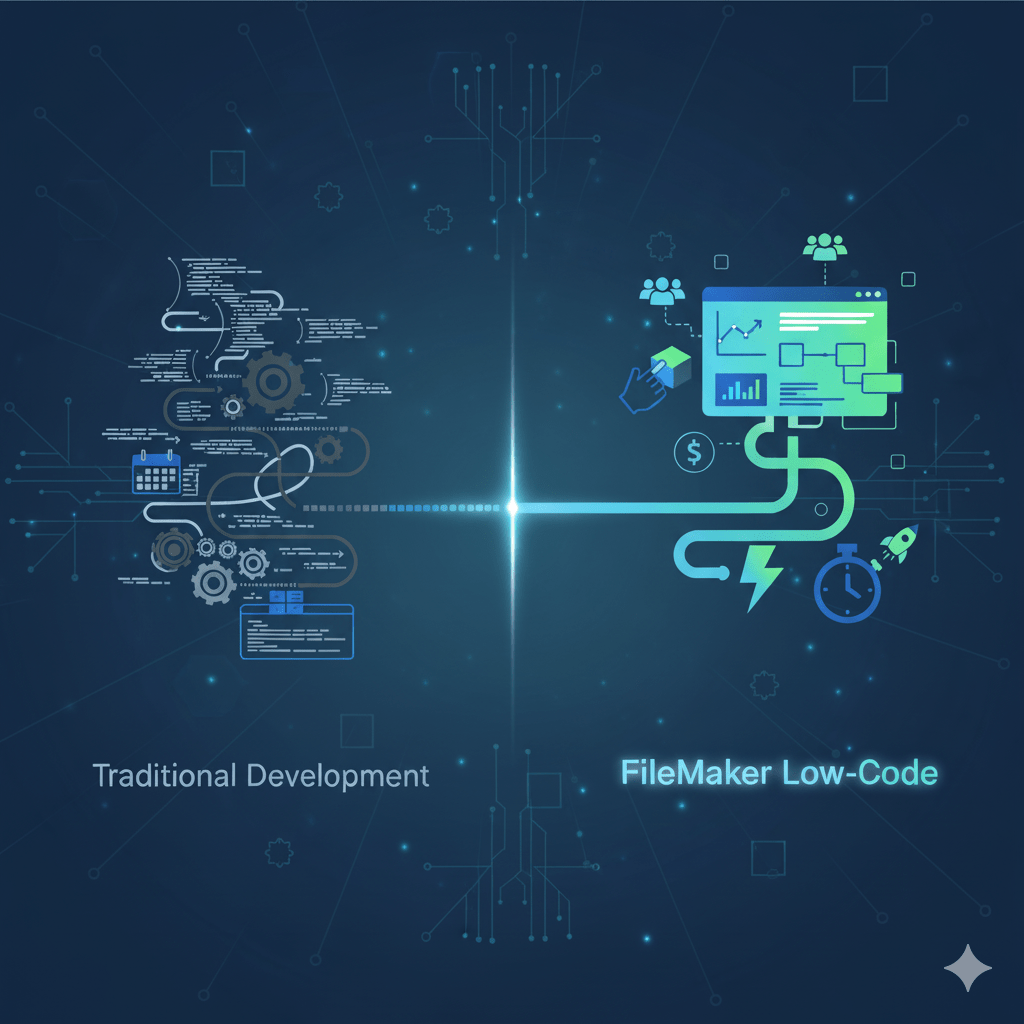
Picking the right way to build your business software is an important choice that will affect cost, time, flexibility, and long-term upkeep. Claris FileMaker, a low-code platform, and traditional software development using standard programming languages and frameworks are two popular ways to make custom business apps. Knowing the differences between these approaches will help you choose the best one for your business. FileMaker lets you make things visually, quickly, and easily.
FileMaker: Visual, Fast, and User-Friendly Development
FileMaker is a low-code development platform with a strong visual interface that lets you make apps quickly. Users can make their own database-driven apps by clicking and dragging elements on a canvas. This makes it easy for people who aren’t good at coding to use. It has a single platform with tools for UI design, scripting, and integration, so you don’t have to switch between different software programs.
The key advantages of FileMaker include:
-
Rapid development: Changes and updates can be implemented quickly, often in real time, speeding up prototyping and deployment.
-
Ease of use: Its visual drag-and-drop design and step-through debugging make it flexible and easier to manage than traditional code-based development.
-
Customizability: While not as granular as full coding, FileMaker allows extensive customization to meet varied business needs.
- Lower barrier to entry: It is suitable for businesses without dedicated programming teams and can be learned in a moderate timeframe
Power and flexibility with complexity in traditional development.
In traditional development, programs are built from the ground up using programming languages like Java, PHP, or.NET that are specifically designed for the job. This method provides:
Maximum flexibility: developers decide what features to add, how users interact with them, how safe the system is, and how it works with other systems.
Scalability: Older tools can handle elaborate business processes and data structures on a large scale.
Source control and collaboration: Well-known frameworks and tools let multiple developers work together at the same time with proper version control.
Which One Works for Your Company?
Whether you use FileMaker or traditional development depends on a lot of things, like the size and complexity of the project, your budget, your schedule, and the experts you have access to.
- Choose FileMaker if your business needs a custom database solution that is moderately complicated quickly and doesn’t cost a lot to build up front. is perfect for small to medium-sized businesses that want an easy-to-use visual tool that can be deployed and changed quickly.
- If you need complex business logic, high scalability, modern responsive interfaces, or enterprise-level security, traditional development is the way to go. It works best for bigger businesses that can afford to have technical teams and longer development cycles.
Businesses have to choose between speed and ease of use and power and flexibility. Some businesses even use more than one method. For example, they might use FileMaker for quick prototypes or departmental solutions while sticking to traditional development for their main business systems.
Final Thoughts
At the end of the day, the choice between FileMaker and traditional development comes down to business priorities. If your organization needs a custom-built, highly complex system with no limitations, traditional development might be the right investment.
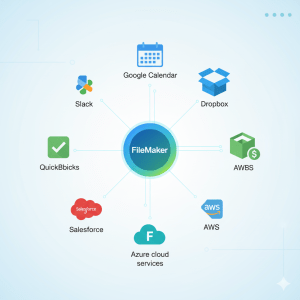
However, if you’re looking for faster delivery, lower costs, and the flexibility to adapt quickly, FileMaker is the smarter option. With its low-code framework, powerful integrations, and cost efficiency, it gives businesses the ability to innovate without the overhead of traditional software development.