Teams are slowed down by manual processes, which also conceal risk and reduce profitability. Switching to automated systems is a strategic move that increases speed, accuracy, and scalability; it’s not just “techy.” This guide explains the importance of automation, how to choose the best initial projects, and provides a workable plan for switching from manual labor to robust, automated systems.
Why automation matters — the business case in plain language
Automation removes repetitive, rules-based work from people so staff can focus on higher-value activities: selling, designing, supporting customers, and solving problems. Evidence shows organizations adopting automation report measurable gains in quality, customer satisfaction, and lower operating costs. The business-process-automation market keeps growing because automation delivers predictable productivity and cost benefits.
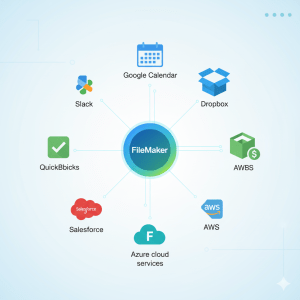
A real-world example: custom apps on platforms like FileMaker (Claris) have replaced paper forms and manual handoffs in many companies—delivering dramatic time savings and cost reductions in fields such as manufacturing, field sales, and service operations.
The most common automation myths — and the truth
- Myth: Automation is only for big companies.
Truth: Low-code and no-code tools let small and medium teams automate quickly without huge IT projects. - Myth: Automation means job cuts.
Truth: The best automation redeploys people to higher-value work and reduces burnout—when paired with good change management. - Myth: Automation is one-and-done.
Truth: It’s iterative. Start small, measure, then scale.
How to choose the right processes to automate (simple prioritization)
Use this quick scoring system to pick your first automation projects:
- Frequency — how often does the task occur? (Daily/Weekly/Monthly)
- Time — how many staff-hours does it consume?
- Error risk — how costly are mistakes?
- Dependency — does it block other work?
- ROI clarity — can you measure time or cost savings easily?
Score each process (1–5) on the five criteria. Prioritize processes with high frequency, high time cost, high error risk, high dependency, and clear ROI. These are winners for early automation.
A practical 6-step roadmap: from mapping to automation
1. Map the process end-to-end
Document each step, decisions, and handoffs. Visual maps expose hidden waits, duplicate work, and where data is copied manually.
Deliverable: a one-page process map.
2. Identify waste and quick wins
Look for repetitive data entry, approvals, manual file transfers, and reporting tasks. These are the lowest-friction wins.
Deliverable: a prioritized list of 3 quick wins.
3. Build the minimum automation (MVP)
Automate one end-to-end flow that removes manual handoffs—use integration tools, workflow automation, or a small custom app. Low-code platforms often deliver an MVP in weeks, not months.
Deliverable: an MVP automation that saves time and reduces errors.
4. Measure impact and iterate
Track time saved, error reduction, and employee satisfaction. Use these metrics to build the case for the next project and to refine the workflow.
Deliverable: a short before/after report with metrics.
5. Harden and scale
Once the MVP proves value, add monitoring, error handling, security checks, and scale integrations to other systems.
Deliverable: production-ready automated flow with logging/alerts.
6. Institutionalize continuous improvement
Run short retrospectives, maintain documentation, and assign automation ownership so the system evolves with the business.
Deliverable: recurring 15–30 minute improvement ritual.
Tools & approaches that work for most businesses
- Integration / iPaaS tools (e.g., Zapier, Make, Celigo) for practical system-to-system automation.
- Low-code / no-code platforms for custom workflows and internal apps—fast to build and adaptable.
- RPA (Robotic Process Automation) for rule-driven desktop tasks where API access is limited.
- Custom apps on platforms like FileMaker/Claris when you need tailored forms, offline/field capabilities, and centralized data control. Real companies using these platforms have replaced paper processes and saved significant time and money.
Common pitfalls — and how to avoid them
- Ignoring change management: Train people, explain benefits, and gather feedback.
- Automating messy processes: Fix the process first—automation freezes bad habits if you don’t.
- Lack of measurement: If you can’t measure, you can’t prove ROI—start with measurable KPIs.
- Siloed point solutions: Design an automation architecture so systems can talk to each other—this avoids new manual handoffs.
Example use-cases with expected outcomes
- Invoice reminders & collections: Automate reminders and status updates → faster cash flow, fewer late payments.
- Order intake to fulfillment: Single source of truth for orders → fewer missed orders and faster cycle times.
- Field data capture (mobile): Replace paper forms with mobile entry → fewer errors and instant sync with back office.
- Executive dashboards: Real-time KPI dashboards → faster decisions with less manual reporting.
Case studies show companies often recover the cost of small custom apps and automation projects within months through labor savings and error reduction.
Quick checklist to get started this month
- Run a 60-minute process mapping session for one critical workflow.
- Score and pick one automation pilot using the prioritization method above.
- Build an MVP using low-code or integration tools.
- Measure time saved in the first 30 days.
- Hold a review and plan the next automation.
Final thoughts — automation as strategic leverage
Moving from manual processes to automated systems is a business strategy, not a technology fad. When executed with clarity—pick the right process, measure impact, iterate—you unlock capacity, improve quality, and let your people focus on value. The smartest leaders use automation to amplify their team, not replace it.
If you’d like, Idiosol can:
- audit one workflow and recommend a prioritized automation plan, or
- build a production-ready MVP on a low-code platform (FileMaker, custom app, or integration stack) within weeks.
Want us to audit your most manual process and give a one-page automation plan? Reply “AUDIT” and I’ll draft the exact next steps.