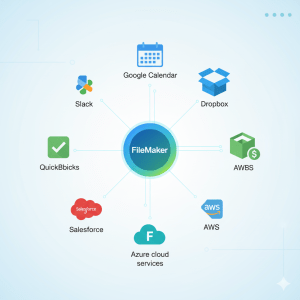
Businesses want ecosystems, not just apps, in the hyperconnected digital world of today. a system in which software tools “talk” to one another in real time, teams collaborate easily, and data flows automatically.
This implies one thing for Claris FileMaker developers: becoming proficient in API integrations is now a fundamental superpower rather than a supplementary ability.
The New Reality of Development
Gone are the days when FileMaker apps existed as stand-alone database systems. Modern organizations depend on dozens of cloud services — from CRMs like HubSpot to payment systems like Stripe, and communication tools like Slack.
A FileMaker solution that can integrate with these systems adds immense business value. APIs (Application Programming Interfaces) make this possible — they’re the digital bridges that connect apps, automate workflows, and extend functionality beyond limits.
Why Every FileMaker Developer Needs API Expertise
Client Expectations Have Evolved
Today’s clients don’t just want a FileMaker app to store data — they want it to sync with everything they use: CRMs, accounting tools, emails, analytics dashboards, and more. Developers who can connect FileMaker to these platforms instantly become more valuable.
APIs Multiply What FileMaker Can Do
Think of FileMaker as a flexible engine. APIs add new gears.
Want to send WhatsApp alerts? Use Twilio.
Want to track payments? Connect Stripe.
Want to sync customer lists? Use HubSpot or Mailchimp.
By mastering APIs, developers turn FileMaker into a digital control center for an entire business.
Boosting Efficiency and Automation
APIs allow you to automate repetitive tasks, like sending invoices, syncing records, or triggering notifications. This not only saves time but also improves accuracy — giving clients a seamless, automated experience.
Commanding Higher Value Projects
API-powered projects are advanced, strategic, and custom-built. Developers with this expertise can charge premium rates and work with larger clients who value innovation.
How APIs Work in FileMaker
APIs communicate through HTTP requests — sending and receiving data between two systems. FileMaker simplifies this using its Insert from URL script step and built-in JSON functions.
A simple integration example:
Insert from URL [ $response ; "https://api.openai.com/v1/models" ]
This retrieves data from an external service. You can then extract what you need using:
JSONGetElement ( $response ; "data[0].id" )
Once developers understand the structure of an API (endpoints, headers, tokens, JSON), integrating any web service becomes possible.
Top Integrations Every FileMaker Developer Should Explore
| Category | Popular APIs | Use Case |
|---|---|---|
| Communication | Twilio, WhatsApp API | Send SMS or notifications |
| Finance | Stripe, PayPal, QuickBooks | Process or sync transactions |
| Cloud Storage | Dropbox, Google Drive | Upload and retrieve files |
| CRM | HubSpot, Salesforce | Sync contacts and leads |
| Marketing | Mailchimp, SendGrid | Automate campaigns |
| AI & Automation | OpenAI, Zapier, Claris Connect | Add intelligence and automation |
Each integration helps create smarter, more powerful FileMaker solutions that clients love.
The Role of Claris Connect
For developers who want API automation without heavy coding, Claris Connect is the go-to solution. It provides prebuilt connectors and workflows that link FileMaker to hundreds of popular apps like Gmail, Slack, or Google Sheets.
With Claris Connect, developers can:
- Build cross-platform workflows visually.
- Eliminate complex scripting for common integrations.
- Speed up delivery time for clients.
It’s the perfect stepping stone between manual APIs and full automation.
Real-World Use Cases
- Automated Payment Tracking
FileMaker integrates with Stripe to record every payment automatically. - Customer Alerts
When an order is ready, Twilio API sends an instant WhatsApp message. - Document Syncing
Uploaded contracts are automatically pushed to Google Drive. - Smart Dashboards
FileMaker pulls live analytics from third-party apps to visualize KPIs.
These integrations make business operations smoother, faster, and smarter — exactly what modern clients expect.
Learning Path: Becoming an API Expert
Here’s how to level up your integration game:
- Learn REST Concepts: Understand endpoints, headers, methods (GET, POST, PUT, DELETE).
- Experiment with Free APIs: Try integrating a weather or currency API first.
- Master JSON Functions: Learn how to extract and format data using JSON in FileMaker.
- Study Authentication: Learn how API keys and OAuth work for secure access.
- Document Your Integrations: Keep a library of successful API setups for future projects.
Once you get comfortable, you’ll realize that every integration follows a similar pattern — and your creativity becomes the limit.
Future of FileMaker Integrations
The future of FileMaker development lies in connectivity and intelligence. Claris continues to expand its API framework, making integrations smoother and faster.
With AI, automation, and cloud adoption accelerating, developers who can integrate FileMaker into multi-platform environments will dominate the industry.
Final Thoughts
APIs are the new coding currency. For FileMaker developers, mastering them means unleashing the full potential of what the platform can do.
Whether it’s connecting to CRMs, automating invoices, or creating smart dashboards — APIs turn FileMaker into a digital powerhouse that drives real business transformation.
So if you’re serious about your development career — it’s time to put on your API cape and start flying.