In every digital project, there’s a critical gap between vision and value — the part where ideas are ready, but users still don’t have a working solution in their hands.
That’s the “last mile” problem — where projects slow down, communication breaks, and businesses lose time and momentum.
But for organizations using Claris FileMaker, that last mile becomes shorter — and often disappears altogether.
Thanks to the agility and problem-solving mindset of FileMaker developers, businesses can deliver solutions faster, adapt in real time, and see measurable value sooner than traditional development paths allow.
What Is the “Last Mile” in Software Projects?
Borrowed from logistics, the “last mile” describes the final stage of delivery — getting the product to the end user.
In software, it’s that tricky transition between development and usability — where a working prototype must turn into a live, reliable, user-ready system.
It’s often where delays happen:
- The system works in testing, but not in real workflows
- User feedback comes too late
- Integration issues surface at launch
- Developers need more time for revisions and approvals
These problems aren’t about technology—they’re about speed, adaptability, and iteration.
Why Traditional Development Struggles with the Last Mile
Conventional development cycles — especially in enterprise systems — follow long, linear paths: planning, design, coding, testing, deployment.
By the time the system reaches users, the business needs may have already changed.
Typical pain points include:
- Rigid frameworks that don’t support rapid updates
- Complex codebases that make small changes expensive
- Slow testing and feedback loops
- High dependency on IT teams for every update
The result? A long delay before the business actually benefits from its investment.
How FileMaker Developers Solve It
Claris FileMaker redefines the last mile by merging speed, flexibility, and collaboration.
Here’s how developers make that possible:
1. Rapid Prototyping & Instant Feedback
FileMaker’s low-code environment allows developers to build live prototypes in hours — not weeks.
Business users can interact with the app early, share feedback instantly, and refine it on the go.
This eliminates the “final surprise” phase that slows most projects.
2. Seamless Integration with Existing Systems
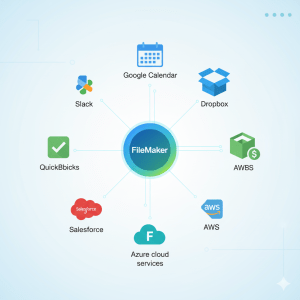
FileMaker developers connect apps directly with your current tools — ERP, CRM, accounting, or cloud platforms — using REST APIs or Claris Connect.
This smooth data flow ensures the solution fits naturally into existing operations, avoiding long integration delays.
3. Modular and Scalable Architecture
Instead of deploying an entire system at once, developers can roll out small, functional modules — each delivering immediate value.
This modular approach lets users start benefiting while additional features are still being built.
4. User-Centric Design and Collaboration
The best FileMaker developers work hand-in-hand with teams — not in isolation.
They understand workflows, map user journeys, and refine UI/UX during development.
The result? No disconnect between what’s built and what users actually need.
5. Continuous Improvement with Low-Code Agility
Unlike hard-coded systems, FileMaker apps evolve continuously.
When requirements change, developers adjust layouts, add scripts, or extend integrations without downtime — keeping the business moving.
The Real Business Impact
When FileMaker developers bridge the last mile efficiently, the effects ripple across the organization:
✅ Faster ROI — because solutions reach production sooner
✅ Lower risk — less waiting, fewer delays, and quicker testing cycles
✅ Higher user satisfaction — users get what they need, when they need it
✅ Improved innovation culture — teams see ideas come to life fast, encouraging more creativity
In short, FileMaker turns the last mile into a launchpad — not a bottleneck.
Example: From Spreadsheet to Live System in Days
A logistics company relying on Excel for shipment tracking needed a live dashboard.
Instead of a 6-month ERP project, a FileMaker developer built a functional prototype in two days.
After two feedback rounds, the system went live in under three weeks — integrated with Google Sheets and their internal CRM.
That’s the “last mile” solved — not by more resources, but by smarter tools and faster iteration.
Why FileMaker Developers Are a Strategic Advantage
Success in the contemporary software industry is determined by speed to value.
FileMaker developers reduce the gap between idea and impact by combining technical agility, creative problem-solving, and business knowledge.
They do more than just write code; they swiftly, shrewdly, and cooperatively turn concepts into action. By developing custom systems that adapt, integrate, and produce tangible results quickly, FileMaker specialists assist companies in overcoming the “last mile” problem.
Because value lost when value is postponed is value lost, and we think your company shouldn’t have either.