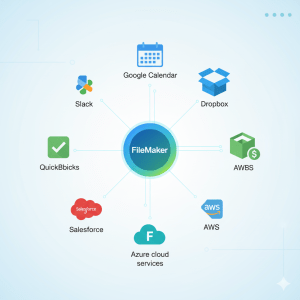
One Smart Platform, Endless Possibilities
In today’s fast-paced digital world, businesses often juggle multiple apps — spreadsheets, CRMs, project trackers, reporting tools, and automation platforms — just to keep operations running smoothly.
But what if you could replace all of them with one?
That’s exactly what FileMaker (by Claris, an Apple subsidiary) empowers developers to do. Skilled FileMaker developers can build custom apps that combine the power of multiple business tools — all within a single, secure, and scalable environment.
Let’s explore how a well-built FileMaker solution can replace six common business tools — and why more organizations are turning to it to simplify their digital ecosystem.
1. Project Management Tool (like Trello or Asana)
Most teams use tools like Trello or Asana to manage workflows, but FileMaker lets developers design fully customized project dashboards — with task assignments, due dates, progress tracking, and team communication all built in.
- ✅ Custom task workflows tailored to your process
- ✅ Progress dashboards that show real-time updates
- ✅ Integration with email or WhatsApp notifications for task alerts
- ✅ Automated reminders for deadlines
With FileMaker, you’re not limited to someone else’s project management structure — it adapts 100% to your team’s workflow.
2. CRM (like HubSpot or Zoho)
A robust Customer Relationship Management (CRM) system is essential for sales and customer success. FileMaker developers can create CRM modules that track leads, clients, interactions, follow-ups, and even payments — all in one app.
- Track every customer interaction
- Link conversations to invoices or tickets
- Get automated sales reports and conversion data
- Integrate with marketing tools or social media APIs
Unlike generic CRMs, a FileMaker CRM is built around your exact sales process, giving you the control and insights big platforms can’t.
3. Inventory Management System (like TradeGecko or Zoho Inventory)
For product-based businesses, keeping track of stock across multiple locations can get messy.
FileMaker developers can build real-time inventory tracking systems that connect directly to sales and purchase modules.
- Live stock updates as sales happen
- Automatic low-stock alerts
- Multi-warehouse management
- Barcode scanning and integration with POS systems
Whether it’s retail, manufacturing, or food service — FileMaker can unify your stock control and sales data into one connected dashboard.
4. Reporting & Analytics Tools (like Power BI or Google Data Studio)
Data matters — but switching between spreadsheets and dashboards is time-consuming.
FileMaker developers can build interactive reporting modules that give you real-time business intelligence.
- Visual dashboards with sales, revenue, and team performance
- Auto-generated daily, weekly, or monthly reports
- Data pulled directly from your live system (no manual exporting!)
- Drill-down analytics with filters by branch, staff, or customer
That means you get custom, live insights — without needing separate analytics tools.
5. Automation Platform (like Zapier or Make/Integromat)
Modern business runs on automation. FileMaker’s scripting and API capabilities let developers automate repetitive tasks — eliminating the need for external workflow platforms.
- Auto-generate invoices after confirmed sales
- Send follow-up emails or WhatsApp messages automatically
- Trigger stock updates when deliveries are logged
- Schedule recurring tasks and reminders
In short, FileMaker can act as your internal automation engine, connecting multiple business systems seamlessly.
6. Form & Data Collection Apps (like Google Forms or Typeform)
From employee onboarding to customer feedback, FileMaker developers can build custom web forms and mobile data collection interfaces that directly feed your main database.
- Collect data offline via FileMaker Go (mobile)
- Create branded web forms for clients or staff
- Instantly store and analyze submissions in one place
- Maintain control with secure, private data access
No more copy-pasting from external forms — every entry instantly syncs to your central FileMaker system.
The Real Power: Integration + Customization
What truly sets FileMaker apart is its integration power. A single app can connect with APIs like:
- WhatsApp, Gmail, or Slack for notifications
- Stripe or PayPal for payments
- QuickBooks or Xero for accounting
- Google Maps for location tracking
This means FileMaker doesn’t just replace multiple tools — it connects them intelligently into one ecosystem.
And since it’s customizable, you can scale it as your business grows — no subscription stacking, no complicated migrations.
Why Businesses Are Switching
- Faster workflows: No need to switch between multiple apps
- Lower costs: One license, no recurring third-party fees
- Data privacy: Everything stays in-house, on your server or Claris Cloud
- Custom logic: Every process matches your exact business model
- Cross-platform: Runs on desktop, web, and mobile (FileMaker Go)
FileMaker developers aren’t just building apps — they’re building complete business operating systems.
Conclusion: One Stack, Infinite Efficiency
The future of business isn’t about using more tools — it’s about making them smarter together.
A proficient FileMaker developer can save your business time, money, and confusion by combining the capabilities of six or more business tools into a single platform.
If you’re tired of juggling multiple apps, maybe it’s time to simplify your tech stack with FileMaker — the smart, scalable solution for modern businesses.