Organizations in the digital transformation era are rethinking processes, culture, and value delivery methods in addition to automating. FileMaker developers, also known as Claris developers, play an important but frequently overlooked role in that journey. These experts serve as a link between the implementation of technology and business vision.
Below, let’s explore why FileMaker developers are indispensable, what skills and mindset they bring, how the evolving platform (especially with AI and cloud) is expanding their role, challenges they face, and how teams can best leverage them.
1. The Unique Position: Bridging Business & Technology
1.1 Translators of Business Logic
Many digital transformation initiatives fail because of the “language gap” between business leaders and technical teams. FileMaker developers are often closer to both worlds: they understand business processes (sales, operations, HR, etc.) and can translate them into functional app logic. This makes them effective in shaping solutions that truly meet real needs.
1.2 Rapid & Iterative Delivery
One of the biggest advantages of FileMaker is rapid prototyping and iteration. Unlike traditional development stacks, changes can often be made quickly, tested, and deployed, meaning transformation initiatives don’t get delayed by long dev cycles. This agility allows businesses to experiment and adjust rather than commit to rigid, monolithic systems.
1.3 Ownership of End-to-End Solutions
FileMaker developers often are responsible not just for coding, but for architecture, UI/UX, integrations, deployment, and support. They can “own” full solution lifecycles—something that in many organizations requires coordination across multiple teams and handoffs. That ownership ensures continuity, faster issue resolution, and deeper domain knowledge.
1.4 Lower Risk of Shadow IT
In many organizations, “shadow IT” arises when business teams bypass IT to build quick tools (Excel, Access, macros, etc.). Having skilled FileMaker developers embedded in transformation projects helps direct that power toward secure, maintainable, governed systems, reducing fragmentation and risk.
2. Platform Evolution Increasing Developer Influence
The role and influence of FileMaker developers are growing because the Claris/FileMaker platform itself is evolving. Recent trends are expanding what’s possible, and making developers even more central.
2.1 AI Integration & Smart Workflows
With the 2025 release of FileMaker, AI is becoming a built-in component. New function calls like AI.Chat and AI.Compute allow apps to interact with language models, summarize text, generate insights, and more. Developers can embed natural language interfaces directly inside business apps.
This puts developers in a pivotal role: they’re no longer just wiring up forms and reports—they’re architecting intelligent decision layers that elevate business value. At Claris Engage 2025, AI was framed as a “superpower” for developers, not a replacement.
2.2 Stronger Integration & APIs
Modern business environments depend on cross-system connectivity. FileMaker 2025 and related tools emphasize improved JSON performance, better API support, and enhanced server-side scripting.
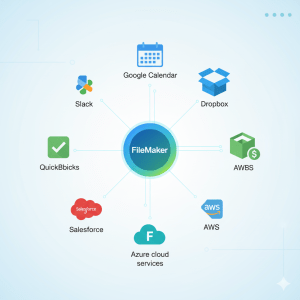
Developers who master these integrations are essential for transforming legacy systems, enabling data flow across CRM, ERP, analytics, etc.
2.3 The Expanding Claris Ecosystem
Claris now isn’t just FileMaker. With Claris Connect and Claris Studio, developers can weave FileMaker solutions into broader ecosystems—building hybrid web apps, automations, and cross-platform workflows.
This amplifies the developer’s role: they become system integrators and orchestrators across cloud, web, and local apps.
2.4 Cloud & DevOps Trends
More businesses prefer cloud deployments (Claris Cloud, hybrid setups). Developers must adapt to CI/CD-like workflows, version control, deployment pipelines, and better governance. As more teams scale multiple solutions, developers who bring DevOps practices to FileMaker become linchpins in transformation teams.
3. Core Skills & Mindset: What Makes a Great FileMaker Developer
To truly drive digital transformation, a FileMaker developer needs more than scripting knowledge. Here are essential attributes and skills:
| Area | Key Skills / Traits | Why It Matters |
|---|---|---|
| Domain Understanding | Deep knowledge of the industry (finance, healthcare, logistics, etc.) | Helps shape solutions that align with real processes |
| Design & UX Sensitivity | Clean layouts, intuitive flows, accessibility | User adoption is crucial for transformation success |
| API & Integration Mastery | JSON, REST, Webhooks, OAuth | Allows apps to connect to modern systems |
| AI & Intelligent Logic | Using AI function calls, natural language processing, smart workflows | Embeds value beyond mere data capture |
| Performance & Scalability | Indexing, server-side scripts, modular architecture | Ensures solutions hold up under load |
| Testing & Reliability | In-app validation, error handling, regression testing | Maintains trust across evolving systems |
| Communication Skills | Presenting to stakeholders, gathering feedback | Essential for collaboration and alignment |
| Continuous Learning | Keeping up with Claris innovations, AI trends, best practices | The platform is evolving fast |
Developers who combine these will not just build apps—they will drive transformation outcomes.
4. How FileMaker Developers Enable Transformation in Practice
4.1 Migrating Legacy & Fragmented Systems
Many organizations run on spreadsheets or disconnected modules. FileMaker developers can consolidate and migrate these into unified apps—reducing duplication, errors, and inefficiencies.
4.2 Creating Data-Driven Cultures
By building dashboards and making data accessible inside operations tools, developers turn raw data into insight. Teams no longer wait for BI teams—they see metrics in real-time inside their day-to-day apps.
4.3 Embedding Intelligence in Routine Tasks
Using AI function calls or script logic, developers can automate classification, content generation, suggestions, and more. For example, generating summaries, auto-filling fields, or prioritizing tasks.
4.4 Enabling Citizen Developers
Senior FileMaker developers often mentor business users or junior developers, enabling them to build below-the-surface solutions. This democratizes app creation under proper guidance, and makes transformation self-sustaining.
4.5 Iterative Innovation & Flexibility
Transformation is not a one-time project. Needs evolve. FileMaker’s agility allows transformation teams to iterate rapidly—tweak workflows, add features, adjust integrations—without redoing everything.
5. Challenges & How to Overcome Them
Even though FileMaker developers are vital, they face some challenges. Recognizing and addressing them helps teams maximize their impact.
5.1 Scope Creep & Feature Bloat
Because changes are easy to apply, stakeholders may request many additions. Solution: enforce clear MVP definitions, staged releases, and governance on scope.
5.2 Performance Issues in Scale
As apps grow (many users, large data), performance becomes critical. Developers must adopt best practices like indexed fields, server-side scripting, efficient relationships, caching, etc.
5.3 Versioning & Deployment Complexity
Managing versions across environments (dev / test / production) can be messy without proper structure. Embrace version control strategies, use modular solution structure, and incremental updates.
5.4 Keeping Skills Up-to-Date
With AI, integrations, and new Claris tools emerging, developers must continuously learn. Participating in conferences (e.g. Claris Engage 2025) and developer communities is vital.
5.5 Balancing Custom vs Standard Tools
Sometimes simpler SaaS tools might suffice. Developers should help stakeholders evaluate when to build custom vs adopt existing solutions, ensuring ROI justifies the custom approach.
6. Future Trends & Why Developers Will Be Even More Important
- AI First Design: As AI becomes native in FileMaker, developers will design “smart by default” experiences.
- Composable Apps: More hybrid apps combining FileMaker, Studio, web, and microservices—developers will orchestrate these pieces.
- No-Code & Citizen Dev Integration: Developers will increasingly act as “enablers”—providing frameworks, templates, and governance for non-technical users to build safely.
- Transformation Strategy Partners: As their influence grows, FileMaker developers will be strategic advisors—helping choose which areas transform, how to phase, and metrics for success.
7. Conclusion
In digital transformation, technology is the enabler—but people make it real. FileMaker developers are uniquely positioned at that intersection. They don’t just deliver apps; they translate vision into workflows, embed intelligence, iterate continuously, and safeguard business continuity.
If your organization is embarking on a transformation journey, make sure you put FileMaker developers front and center. Give them domain access, trust them with integration, and invest in their continuous growth. They are not just coders — they are the backbone that will ensure your transformation is intelligent, resilient, and user-centered.