In modern organizations, successful projects rely not just on good technology or innovative business ideas — they depend on effective alignment between business teams (strategy, operations, stakeholders) and technical teams (developers, engineers, IT). This alignment gap often causes delays, miscommunication, mismatched expectations, and wasted effort.
That’s where FileMaker developers — developers working on the FileMaker platform — play a uniquely powerful role. They act as bridges: translating business needs into technical solutions, and technical capabilities into business value.
Understanding the Key Roles: Business Teams vs Technical Teams
Business teams typically focus on:
- Defining objectives, KPIs, desired outcomes
- Understanding workflow, user needs, process inefficiencies
- Budgeting, stakeholder priorities, timelines
Technical teams focus on:
- Architecture, databases, interfaces, integrations
- Performance, security, scalability, maintainability
- Coding, testing, deployment
These two groups often speak different languages: business terms vs technology jargon. When misaligned, the result can be systems that work technically but don’t meet business needs — or business ideas that are poorly translated into usable software.Why FileMaker Developers Are Ideal Bridges
Below are the reasons why FileMaker developers are particularly well‑suited to bridge the gap between business and technical teams.
1. Platform built for both business logic and rapid development
FileMaker combines database, UI/layout design, scripting, and deployment capabilities in one platform. It allows developers to rapidly build apps that reflect business workflows.
For example, FileMaker promotes itself as a “Workplace Innovation Platform” that enables teams to “build custom apps to match unique business needs and helps to better connect your systems, processes, and employees.”
Because of this all‑in‑one nature, FileMaker developers don’t have to spend excessive time on plumbing separate layers — they can more quickly prototype, iterate, and align with business feedback.
2. Strong business‑process understanding
Many FileMaker development firms emphasise their role as not just “tech developers” but business solution providers. For example, one consultancy states:
“Our team of certified FileMaker consultants knows FileMaker inside out. We develop applications that help leverage power throughout your company, and will serve as a dedicated partner in your quest towards the perfect business software workflow.”
This framing shows that FileMaker developers are already thinking in business‑terms (workflows, productivity, value), and thus can translate business language into technical solutions and vice versa.
3. Effective communication with both sides
Because FileMaker developers often work both with business stakeholders (defining needs, processes) and with technical details (database schema, scripting, integrations), they gain fluency in both domains.
A developer might take a business user’s description of a manual process (“we collect invoices on paper, then someone re‑types into Excel”) and convert it into a FileMaker layout + workflow + automation, and then translate technical constraints (“we’ll need a relational schema here, and indexing for performance”) back into business terms (“this means we’ll design a single source of truth and avoid duplicate data entry, which saves X hours/week”).
4. Iterative development keeps business teams engaged
Business teams can see working models early, provide feedback, and adjust requirements in real time because FileMaker speeds up prototyping. By doing this, the “handoff” risk—whereby the business transfers requirements and then checks only after complete development—is decreased.
This engagement helps technical teams stay on course and keeps business teams in sync. Thus, FileMaker developers minimize gaps and improve alignment.
5. Integration and scaling for technical growth
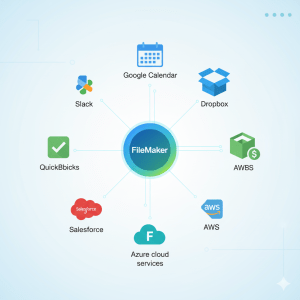
FileMaker solutions aren’t isolated; they often integrate with other systems, expose APIs, connect mobile/web interfaces. Skilled FileMaker developers know both business angle (why integrate?) and technical angle (how integrate?). For example, they manage system integration, automation and data flows.
Thus, they help business teams understand the value of integration (data visibility, workflow automation) and help technical teams design the integration architecture — literally bridging the two.
Impact of That Bridge Role
What tangible outcomes does this bridging deliver?
- Faster time‑to‑value: Business teams get working apps sooner, thanks to the prototyping and alignment.
- Better fit between solution and business need: Because the developer actively engages with business logic.
- Reduced re‑work: Fewer mis‑understood requirements, less “technical build doesn’t match what business wanted”.
- Better adoption: Business users are more likely to adopt solutions when they feel their input is heard and earlier prototypes reflect their needs.
- Scalable growth: Because technical architecture is considered early (via integration, data modelling), the solution can evolve rather than collapse as growth happens.
Challenges & Considerations
While FileMaker developers are strong bridges, be aware of some caveats:
- Scope creep from business side: With rapid prototyping, business teams may continuously add new ideas. The developer must manage scope, expectation and ensure alignment with technical feasibility.
- Technical depth vs enterprise scale: For extremely large scale public‑apps, or highly complex distributed systems, FileMaker might require heavier architecture or other platforms. The FileMaker developer must still liaise with wider IT architecture.
- Communication discipline: Being the bridge means the developer must intentionally spend time listening, clarifying business needs, translating back to both sides — not just coding. If they lean only technical, the bridging fails.
- Change management: Business teams may be used to legacy workflows; the developer must facilitate change, training, and ensure adoption, which extends beyond code.
Best Practices for Organizations Leveraging FileMaker Developers
To maximize this bridging role:
- Involve business users early: Bring them into prototyping sessions, requirement workshops, feedback cycles.
- Have the developer act as translator: Let them facilitate sessions between business and tech teams.
- Use iterative development: Build small, release early, iterate based on user feedback — this keeps both sides engaged.
- Define integration points: Technical teams and business teams together define what external systems/data need to be connected — helps avoid surprises later.
- Communicate regularly: Developer should provide status updates in business terms (what workflows streamlined, what metrics improved) and technical terms (what database changes, what integrations done) so both teams stay aligned.
- Plan for growth: While you might start small with FileMaker, ensure the architecture is ready to scale or integrate with wider systems.
Conclusion
In the dynamic intersection of business strategy and technical execution, the role of “bridge” is critical. Developers of the FileMaker platform are uniquely positioned to fill that role, thanks to their fluency in business logic, rapid app‑building capability, and strong technical skills.
When organizations recognise this role and leverage FileMaker developers as translators and connectors — not just coders — they unlock faster, better‑aligned solutions that truly serve business needs.
If you’re embarking on digital transformation, workflow improvement, or custom app development — consider not just “which platform” but also how well your developer can bridge business and tech. In that equation, a skilled FileMaker developer may be one of your most strategic assets.