In the startup and product-development world, the term “MVP” (Minimum Viable Product) has become almost ubiquitous. It refers to delivering the simplest version of a product that is usable enough to test value, gather feedback, and iterate.
Yet when we talk about which tools and platforms enable MVPs fastest, much of the spotlight is on the usual suspects — modern web stacks, JavaScript frameworks, no/low‑code platforms, etc. What tends to be overlooked is the role of FileMaker developers. I contend that FileMaker practitioners are among the fastest MVP builders, for reasons worth examining.
What is FileMaker?
Before diving into its MVP prowess, let’s summarise what FileMaker is:
- FileMaker is a cross‑platform relational database application and development environment created by Claris (a subsidiary of Apple).
- It combines a database engine, GUI tools, scripting, layouts/interfaces, plus web/mobile capabilities.
- It has, over recent years, evolved from purely “desktop database” tool to support web, mobile, APIs, integrations and low‑code features.
- It is often used by organizations of all sizes for internal business‑apps, custom workflows, data‑consolidation, dashboards, etc.
So, FileMaker is a legitimate development environment — not a toy or purely “for non‑developers.” Put another way, it gives developers significant leverages.
Why FileMaker Developers Excel at MVPs
Here are the key factors that make FileMaker developers fast, efficient and often overlooked in the MVP conversation.
1. Rapid app development environment
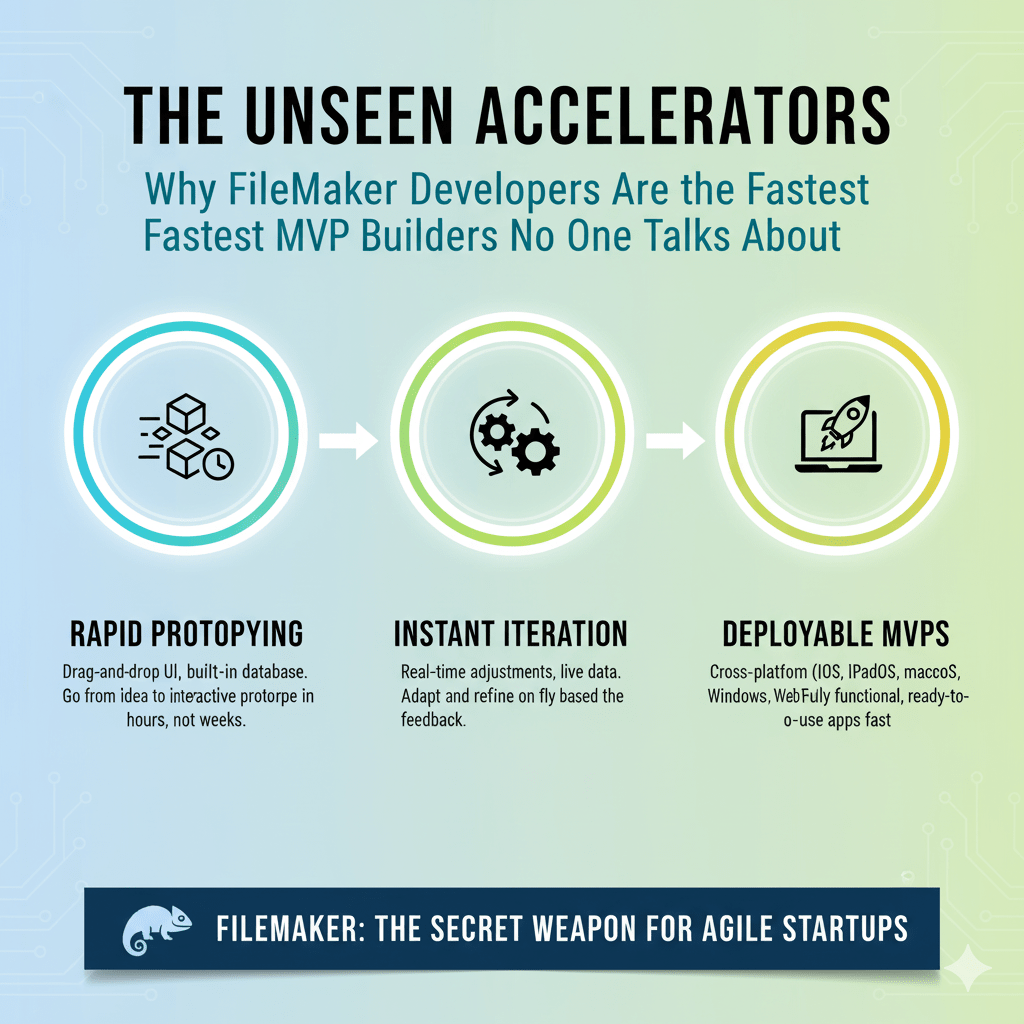
One of the major selling‑points of FileMaker is its speed in going from concept → working application. For example:
- It offers drag‑and‑drop layouts, built‑in components, pre‑packaged behaviors, which reduce boilerplate.
- FileMaker itself claims it “eliminates time‑consuming manual processes” and “accelerates business operations”.
- A blog notes: “one of the biggest draws … is its ability to take a concept from inception to prototype in record time.”
Thus, when your goal is to build an MVP (which requires minimum feature‑set, fast turnaround, feedback loop), FileMaker hits many of the “fast” boxes.
2. Built‑in database + UI + deployment stack
Unlike many traditional stacks where you need to wire up database schema, backend logic, APIs, UI, hosting etc, FileMaker integrates all of those in one environment.
This means fewer layers of integration, fewer decisions about architecture, fewer “glue” pieces to assemble. A FileMaker developer can focus more on business logic and less on infrastructure plumbing.
This is fertile ground for MVPs, because the goal is not to build everything perfectly, but to deliver something usable quickly. And this is aligned with classic MVP goals (reduce time, cost, validate market) from many articles.
3. Low‑code and accessible for business logic
FileMaker has low‑code qualities: layouts designed visually, scripting interface, built‑in functions, and relatively less reliance on full stack coding (though full coders can extend).
For MVPs especially, this means less time spent on “wiring up” and more time spent on “solving the user problem.”
As one article states: “The platform’s intuitive interface allows for rapid prototyping and iteration.”
Therefore, FileMaker developers can be quicker to get working versions into user hands.
4. Cross‑platform, built in
An MVP must frequently be cross-platform (desktop, mobile, and web) in order for users to test in authentic settings. FileMaker is compatible with web browsers, iOS, Windows, and macOS.
At least in the early MVP stage, this eliminates the need to launch distinct mobile apps or specialized web front-ends. Faster delivery due to less fragmentation.
5. Real‑world evidence and use‑cases
There are concrete examples of FileMaker being used for mission‑critical applications at scale, which lends credibility to its speed + stability. For example:
- ESPN Netherlands used FileMaker for their broadcast production operations; they described FileMaker as “the perfect, rapid application development environment … by providing short iterations, power, flexibility and stability.”
- Another article highlights FileMaker’s performance improvements and time‑to‑deploy advantages.
When you’ve got real businesses relying on it, this adds weight to the argument that FileMaker developers are “fast MVP builders.”
Why They’re “No One Talks About”
Despite the advantages, FileMaker developers are rarely cited in the MVP‑buzz or startup‑stack discussions. Why?
1. Platform perception & marketing
FileMaker has historically been associated with desktop databases, “small business tools”, or internal business apps rather than “digital startup MVPs”. Some commentary suggests the developer community feels under‑hyped. For example one post:
“when I tell people I’m a FileMaker developer they say, ‘I’ve never heard of that.’”
So it suffers from perception issues; fewer folks equate “FileMaker” with “rapid startup MVP”.
2. Scalability & public‑facing app concerns
Some developers cite concerns about FileMaker’s scalability for high‑volume or public‑facing apps. For instance:
“performance issues as systems grow — once you reach 100+ users speed and responsiveness start to decline noticeably.”
Thus, while FileMaker is great for early MVPs and internal apps, it might be less cited for “public web‑scale” MVPs. That may mean it’s overlooked in startup/VC‑type conversations.
3. Startup stack culture focus
Many startups today talk about “React + Node + AWS Lambda + microservices” or no/low‑code like “Bubble.io”, “Flutterflow” etc (see e.g., top MVP builders list).
FileMaker doesn’t always get the same attention in those lists, probably because of its enterprise / internal‑app focus rather than “public consumer apps”.
4. Developer niche & ecosystem size
FileMaker has a strong but smaller ecosystem compared to mainstream web stacks. This means fewer tutorials, fewer blog posts about MVPs built in FileMaker, fewer stories in startup media. So the “fast MVP FileMaker developer” narrative stays quieter.
What This Means for Businesses & Startups
Given the above, what are the implications if you are a business, startup, or thinking about building an MVP?
✅ Consider FileMaker early if speed + business logic matter
If you want to test a business process, internal workflow, or get a working product to users quickly (especially in the “internal apps / B2B operations” domain), then selecting FileMaker + a skilled developer can be a strategic win.
✅ Get expert FileMaker developers who can deliver
Since you’re relying on a platform that’s designed for speed, make sure you get someone familiar with the best practices (data modelling in FileMaker, scripting performance, integrations). A developer who knows how to leverage FileMaker’s strengths will give you more head‑start than a developer unfamiliar with the platform.
✅ Be mindful of future scale & tech‑stack growth
If you anticipate very large user base, high concurrency, or multiple user‑types across public web, you should still evaluate FileMaker’s fit for long‑term scaling or plan for transition. As one review noted, performance and licensing can become limitations.
So, use FileMaker for MVP, prototype, internal solutions — and consider long‑term roadmap if needed.
✅ Use FileMaker to validate business value, then decide scale
Because FileMaker can deliver fast, you can use it to test your idea, evaluate user adoption/feedback, and once validated, decide whether to scale within FileMaker, upgrade architecture, or migrate to another stack. This aligns perfectly with MVP strategy (validate first, invest later) as described in the MVP literature.
✅ Leverage integrations & extensions
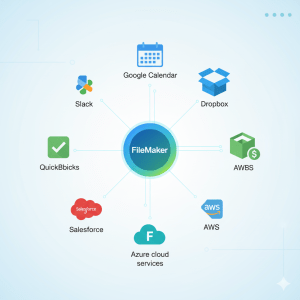
Modern versions of FileMaker support APIs, JavaScript integrations, web viewers, drag‑and‑drop add‑ons, etc.
So you can build an MVP that isn’t just a “simple internal form tool” but something that connects to other services, has web/mobile access, etc — again enhancing its value.
Challenges & Considerations
It’s not all roses, of course. Here are some challenges when using FileMaker for MVPs:
- Licensing and cost per user might limit very large public user‑bases.
- If you expect extremely high traffic, heavy concurrency, extremely large datasets, or real‑time public‑facing apps, you might hit limitations.
- Developer skill matters — though FileMaker is “quick”, poorly structured FileMaker apps can degrade. There is a learning curve (e.g., table‑occurrences graph, scripting best‑practices) as noted by developer feedback.
- The marketing & community around MVPs often ignore FileMaker, so you may need to champion your choice internally, and possibly face questions about “why not React/Node”.
Conclusion
In the rush to build MVPs, we talk a lot about modern web frameworks, no/low‑code tools, microservices, etc. But the role of FileMaker developers as MVP builders is underrated. Because FileMaker offers rapid development, an integrated stack (UI + DB + scripting), cross‑platform support, and strong development productivity, developers skilled in FileMaker can build MVPs faster (and often cheaper) than many realise.
If you are a startup looking for speed to market, or a business wanting to test a workflow or product concept, then engaging a FileMaker developer might just give you the competitive edge. They’re the “silent MVP builders” that few talk about — but many should.