Project overview
The client is a growing clinic offering general consultations, diagnostic testing and patient rehabilitation. As patient numbers increased, its existing way of managing records, appointments and billing started to cause delays and occasional errors.
The challenge
Each department was working from a different system, and much of the patient information was still on paper.
- Patient records
- Paper files and outdated software led to misplaced records and slow access to important information.
- Scheduling
- Appointments were not linked to patient records, which caused double bookings and missed appointments.
- Billing and insurance
- Tracking payments, insurance claims and balances was difficult, delaying income and creating administrative errors.
- Coordination
- Reception, medical staff and billing used separate tools, increasing the risk of mistakes between hand-offs.
Requirements
- Centralised digital patient records
- Scheduling linked directly to patient files
- Billing with insurance and payment tracking
- Shared information across reception, clinical and billing teams
- An interface staff could adopt without lengthy training
The solution
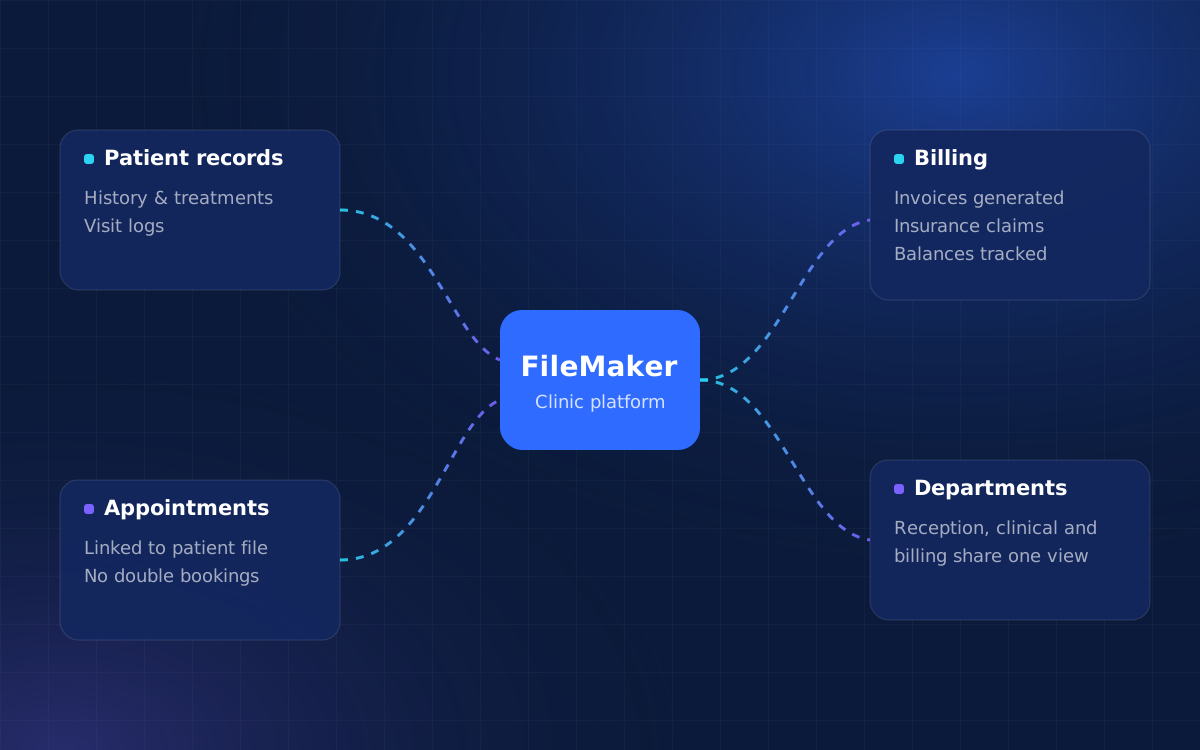
The clinic chose FileMaker to build one platform that brought these functions together, tailored to its own processes.
- Patient record management
- A central database for medical history, treatments and visit logs, quick to search and update.
- Integrated scheduling
- Appointments linked to patient records, removing double bookings and putting patient details in front of staff when they book.
- Billing module
- Invoices generated automatically, with payments, insurance claims and outstanding balances tracked in one place.
- Cross-department coordination
- Front desk, medical staff and billing share information in real time.
How we implemented it
- 1
Digitise records
Move patient information into a structured FileMaker database.
- 2
Link scheduling
Connect the appointment calendar to patient files.
- 3
Automate billing
Build invoicing and insurance tracking on the same data.
- 4
Connect departments
Give each team the views it needs on shared records.
Results
- Better-informed care
- Clinicians had patient information available at the point of care.
- Smoother scheduling
- Linking appointments to records removed double bookings and reduced missed appointments.
- Quicker billing
- Automated invoicing and claim tracking shortened the revenue cycle and cut administrative work.
- More time for patients
- Staff spent less time on paperwork and more on patient care.
Why it matters
In a clinic, information gaps turn directly into patient inconvenience. Putting records, appointments and billing on one platform made each hand-off between departments simpler and more reliable.